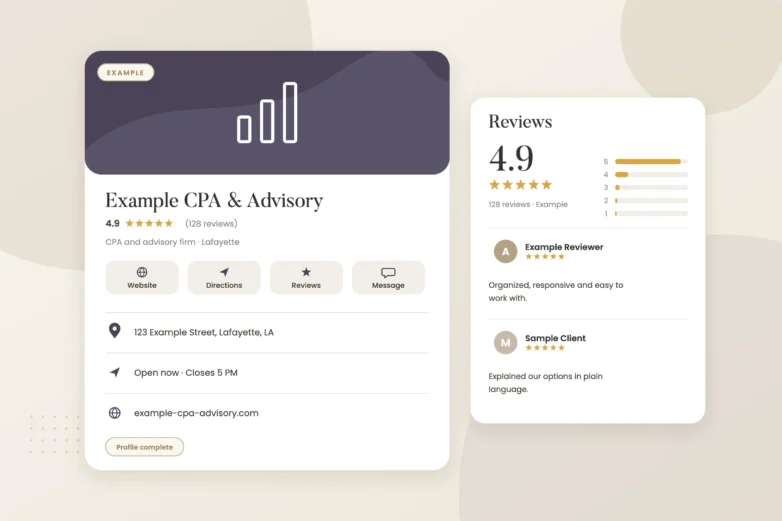
Local SEO is no longer only about ranking on page one. Your business also needs to be clear enough for AI tools to understand, trust, and recommend. People now compare businesses through Google Search, Google AI Overviews, ChatGPT, Gemini, Perplexity, map results, social platforms, reviews, and directory listings before they ever call. That means your online footprint has to work as one connected trust system.
AI search optimization, sometimes called generative engine optimization or GEO, is not a replacement for SEO. It is the next layer of visibility. For law firms, insurance agencies, medical practices, physical therapy clinics, and professional service businesses, the strongest AI-search strategy starts with the same fundamentals that support local SEO: clear service pages, consistent business information, helpful content, strong authority signals, and a website that explains your expertise in plain language.
What is AI search optimization?
AI search optimization is the process of making your business easier for answer engines to understand. Instead of only trying to rank a single page for a single keyword, the goal is to make your brand, services, locations, expertise, and trust signals clear across your website and online profiles. The better your business is explained, the easier it is for search engines and AI tools to connect you with relevant questions.
For example, if someone asks an AI tool for a marketing agency that helps law firms with local SEO in Lafayette, the tool needs to understand who Abode is, what we do, where we serve, what industries we focus on, and why we are relevant. That understanding comes from structured website copy, internal links, service pages, blog content, business listings, social proof, and consistent mentions across the web.
Why this matters for law firms and service businesses
High-trust service businesses are often chosen through research. Someone looking for an attorney, insurance advisor, surgeon, therapist, or specialty service provider wants credibility before contact. AI search tools summarize options, compare information, and pull from content that feels clear and authoritative. If your website is thin, vague, or missing important service details, you may be harder for AI tools to recommend.
This is especially important for law firm marketing. Legal clients often search around a problem before they search for a specific firm. They may ask what to do after a wreck, how long a claim takes, what questions to ask an attorney, or which type of lawyer handles a specific issue. If your firm has helpful content and strong service pages, you have more opportunities to be understood as a relevant answer.
The local SEO basics still come first
AI visibility is built on the basics. Your Google Business Profile should be complete. Your name, address, phone number, website, categories, and services should be consistent across directories. Your website should clearly explain who you serve, what you offer, and where you work. Your service pages should be specific. Your content should answer real questions. Your internal links should help readers and search engines move through related topics.
Before chasing AI visibility, check whether your local foundation is clean. Directory errors, missing listings, inconsistent phone numbers, and vague service pages can all weaken your search presence. Use the free visibility check to find listing issues, then connect those fixes to your website and content plan.
How to make your business easier for AI to understand
Start by making your website more explicit. Your homepage should say what you do and who you help. Your service pages should describe each offer. Your industry pages should explain the audiences you understand. Your about page should show credibility. Your blog should answer questions tied to services, locations, and decision points. Your FAQs should use the same language real clients use when they search.
Internal linking matters here. A blog about AI search should link to local SEO, website design, content strategy, law firm marketing, and the contact page. A law firm marketing page should link to blogs about Google Business Profile, reviews, practice-area pages, AI search, and local ranking factors. These links create a topical map that helps both users and search systems understand the relationship between your pages.
Structured data reinforces that clarity. Google’s own documentation on FAQ structured data explains how marking up your questions helps search systems understand and surface them, and Google counts consistent profile and citation signals among the local ranking factors that both map results and AI-assisted answers draw from.
AI search rewards clarity, not fluff
The most common mistake is using vague marketing language everywhere. Phrases like “full-service solutions,” “tailored strategies,” and “next-level growth” do not tell search engines much. Clear copy is stronger: local SEO for law firms, Google Business Profile optimization, website copy for medical practices, insurance agency lead generation, Lafayette marketing agency, Acadiana service-area pages, and AI search visibility for local businesses.
This does not mean keyword stuffing. It means using the words your clients use and placing them where they make sense: titles, headings, introductions, service descriptions, FAQs, image alt text, internal links, and calls to action. A good marketing strategy balances search terms with a human voice.
What pages support AI search visibility?
The strongest local websites usually include a homepage, about page, services page, individual service pages, industry pages, blog posts, FAQs, case studies, and a clear contact page. For Abode, that means pages for Local SEO, Website Design, Google Ads, Content & Social Media, Law Firms, Insurance Agencies, Medical Practices, and other trust-based industries.
For a client, the exact page map depends on the business. A law firm may need practice-area pages and service-area content. An insurance agency may need pages for different coverage types. A medical practice may need condition, treatment, provider, and location content. AI tools need enough detail to understand the business from more than one angle.
How blogs help AI and Google visibility
Blog posts help you cover questions that are too specific for a core service page. They also create supporting content that can link back to important pages. For local businesses, strong blog topics often include comparison posts, process explainers, local guides, FAQs, “what to expect” articles, and problem-aware posts that match early-stage searches.
For example, a law firm could publish articles about what to do after an accident in Lafayette, how Louisiana injury claims work, questions to ask before hiring a lawyer, or how Google reviews influence local trust. A marketing agency can publish articles about law firm marketing in Lafayette, Google Business Profile strategy, local SEO, website structure, and AI search optimization.
What to measure beyond rankings
Traditional rankings still matter, but AI search visibility requires a broader view. Watch branded searches, Google Business Profile actions, directory consistency, organic traffic to service pages, blog-assisted conversions, form submissions, calls, and which content appears in search results or AI summaries. The goal is not only to show up. The goal is to show up with enough trust that people choose you.
If your business is investing in SEO, website design, ads, and content, those efforts should be connected. A paid ad can send someone to a page that also ranks organically. A blog can support a service page. A Google profile can reinforce the same service language. A contact page can make the next step easy.
Want to know if your business is easy to find?
If you are not sure how your business appears across search, maps, directories, and AI-driven discovery, start with the basics. Check your listings, review your website structure, read your service pages like a potential client, and search your business category in nearby towns. Look for gaps, vague copy, inconsistent details, missing FAQs, and weak calls to action.
Abode helps service businesses build visibility systems that support Google, local search, and AI search together. Book a strategy call if you want to see where your business could be clearer, stronger, and easier to recommend.
Related resources for AI and local search
- Local SEO & Visibility
- Website Design & Copy
- Law Firm Marketing in Lafayette, LA
- Local SEO, Google Ads, and Website Content for Louisiana Businesses
- Frequently Asked Questions
Frequently Asked Questions
How do you get a local business cited in ChatGPT or Perplexity?
AI search engines pull from indexed web content with clear structure, semantic markup, and authoritative answers. To get cited: publish FAQ content that answers specific questions in plain language, deploy FAQPage and Speakable schema markup, build a complete Google Business Profile (which AI engines now read), and earn citations from other local sites.
Does schema markup help AI search visibility?
Yes. FAQPage, LocalBusiness, LegalService, MedicalBusiness, and Speakable schema all make it easier for AI engines to confidently pull and attribute content. Sites without structured data still get cited, but sites with good schema get cited more often and more accurately.
Is AI search replacing Google for local search?
Not yet u2014 but it's growing fast. Google AI Overviews, ChatGPT search, and Perplexity now answer a meaningful percentage of local-intent queries before the user clicks. Local businesses that show up in those AI answers get the first impression; businesses that don't get skipped over even when their traditional rank is fine.
Want to see where your business stands today?
I take one client per niche, per market. Before we ever talk about working together, I’ll send you a free visibility audit — a focused review of your website, Google presence, reviews, and how you currently show up in local search. You’ll get a one-page summary of what’s working and what’s missing, whether you hire me or not.
You can also see what current and past clients say about working with me.
— Kayce Sadler, Abode Marketing | Youngsville, Louisiana


You Might Also Like