How Louisiana Medical Clinics and Medspas Can Attract More of the Right Clients

A medspa owner in Lafayette told me she had tried three marketing agencies before we talked. One ran Facebook ads that brought in clients who weren’t a fit for her pricing. One built a new website that looked great but didn’t show up in any local search results. The third charged a monthly retainer, sent reports with lots of charts, and couldn’t explain what any of the numbers meant for her actual business.
Medical clinics and medspas have a specific marketing problem: you’re selling expertise and trust in an industry where the wrong kind of visibility is worse than none at all. Getting in front of the wrong clients — people who aren’t a fit for your services or price point — is a waste of time for everyone. And the strategies that work for a national brand selling products don’t translate to a single-location medspa or specialist clinic in south Louisiana.
Start With Who You’re Actually Trying to Reach
Before any tactic, you need to be specific about your client. Not “women who want aesthetic treatments” — which specific women, in which zip codes, looking for which specific treatments? A medspa in Lafayette that does high-end injectables and skin resurfacing has a different ideal client than a medspa in Baton Rouge that does laser hair removal and facials at accessible price points. Same industry, completely different marketing strategy.
The same specificity applies to medical practices. A pain management clinic that works primarily with workers’ compensation patients has different referral sources and different marketing needs than a concierge family practice in Prairieville that’s attracting privately-insured patients willing to pay a premium for same-day access.
Get clear on this first. Everything else — which platforms, which content, which ad targeting — follows from knowing exactly who you’re talking to and what they care about.
Google Business Profile: Your Most Important Asset That Most Practices Underuse
For both medspas and medical clinics in Louisiana, Google Business Profile is the highest-leverage marketing asset you have, and most practices are treating it like an afterthought.
“Best medspa near me.” “Pain management clinic in Baton Rouge.” “Physical therapy Lafayette LA.” These are high-intent searches from people who are ready to call or book. The practices that appear in the map pack at the top of those results get the calls. The ones that don’t, don’t.
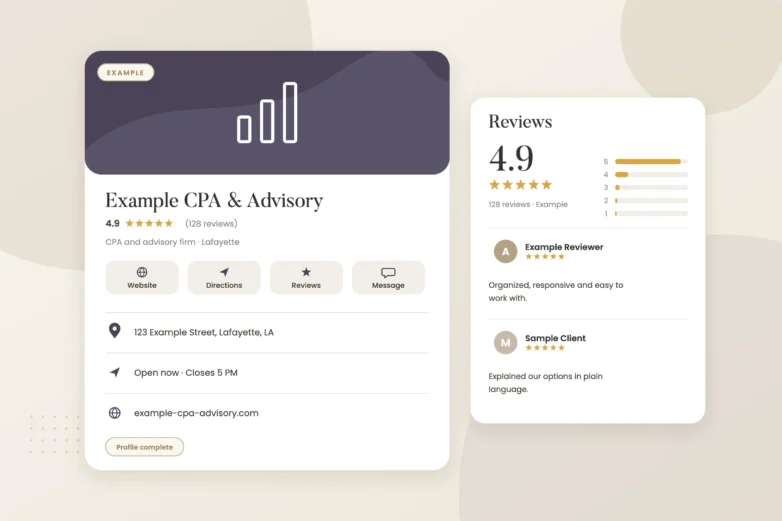
What a complete, well-maintained Google Business Profile includes: accurate hours that are actually kept current; professional photos of the actual space and the actual practitioners (not stock photos); a complete list of services with descriptions that match how clients search; a steady accumulation of real client reviews; and regular posts that signal to Google that the business is active. Most medical practices and medspas I audit are missing at least three of those five.
Reviews: The One Thing That Makes Everything Else Work Better
For healthcare and aesthetic practices, reviews carry more weight than almost any other marketing signal. Someone considering a medspa for injectables is going to read reviews carefully — not just the star rating, but what people actually said about their experience, the results, and whether the practitioner listened to them.
Building a strong review base requires two things: asking consistently, and making it easy. Text your clients a direct link to your Google review page within 24 to 48 hours after their appointment. Don’t wait until weeks later — the emotional peak of a good experience is right after it happens. A one-sentence ask — “If you were happy with your visit, we’d really appreciate a quick Google review” — is all it takes most of the time.
For medical practices, there are HIPAA considerations in how you follow up with patients — be thoughtful about what’s in any outbound message. But there’s nothing preventing you from including a general review request in your checkout process or in a post-visit survey.
Website Content That Converts Visitors Into Clients
Most medical and medspa websites have the same problem: they list services without telling potential clients what to expect. “Botox” isn’t a page — it’s a word. A page that converts tells someone: what this treatment involves, who it’s right for, what the experience is like, what results to expect and when, and what it costs (or at least a starting-from price). That level of specificity builds confidence. Someone who leaves your website knowing exactly what to expect from a treatment is more likely to book than someone who had to guess.
For medical practices, the same principle applies to condition-specific pages. A physical therapy practice with a detailed page about what therapy for rotator cuff injuries actually involves — including timeline, what the exercises look like, and what outcomes are typical — is going to outperform a practice that just says “we treat shoulder injuries” on a services page.
These pages also rank better in search because they contain the specific language people use when they search. Someone searching “how long does Botox last” or “what to expect from physical therapy after ACL surgery” is more likely to land on a page that actually answers those questions than one that doesn’t mention them.
Paid Search for Medical Practices and Medspas: When It Makes Sense
Google Ads can work very well for medspas and medical practices — particularly for specific, high-value treatments and services where the economics support a cost-per-acquisition. A medspa charging $600 for a treatment package can afford to pay $40 or $50 per qualified lead from Google Ads and still be profitable. A family medicine clinic trying to build a panel at insurance-reimbursed rates probably can’t.
The key word is “managed.” Medical and medspa Google Ads campaigns that run unattended will burn through budget on irrelevant searches and geographic areas outside your service radius. Someone needs to be monitoring the search terms regularly, excluding the ones that aren’t converting, and adjusting bids based on actual performance data. If nobody is doing that, the ads won’t pay for themselves.
Compliance and Advertising Rules in Medical Marketing
Medical practices and medspas operate under state and federal advertising guidelines. In Louisiana, medical advertising is regulated by the Louisiana State Board of Medical Examiners and related professional bodies. The rules vary by license type, but common constraints include: no claims of guaranteed outcomes, no testimonials that could be misleading, specific requirements around before-and-after imagery.
I’m not your compliance officer, and any marketing strategy for a medical practice should be reviewed by someone familiar with the specific rules that apply to your license and specialty. What I can say is that good marketing for a medical practice doesn’t need to make claims it can’t support. The specificity, the honesty, and the proof of competence that makes content marketing work for a medical or aesthetic practice is entirely achievable within the bounds of ethical advertising.
Want to see where your business stands today?
I take one client per niche, per market. Before we ever talk about working together, I’ll send you a free visibility audit — a focused review of your website, Google presence, reviews, and how you currently show up in local search. One page of feedback, whether you hire me or not.
You can also see what current and past clients say about working with me.
— Kayce Sadler, Abode Marketing | Youngsville, Louisiana
Frequently Asked Questions
How can a Louisiana medspa attract more clients?
Publish clear, treatment-specific pages with pricing or starting-from pricing, real before-and-after photos with proper consent, and an active Google Business Profile with weekly posts and a steady review habit. Most medspa sites lose prospective clients by burying the basics; the ones that spell out what a treatment involves, who it is for, and what it costs convert far better. Louisiana medical advertising is overseen by the Louisiana State Board of Medical Examiners, so keep claims honest and outcomes realistic. More on the fundamentals in our Louisiana medical practice local SEO guide.
What marketing works best for medical clinics in Louisiana?
Condition-specific content pages, a complete Google Business Profile, a consistent review routine, and clear next-step instructions on the website. Clinics that explain their care process in plain language attract higher-intent patients. When you ask for and display reviews, follow the FTC guidance on endorsements and reviews, with no incentivized or edited testimonials. For a deeper playbook, see how to get more patients for your Louisiana practice and our local SEO approach.