How to Rank Higher on Google Maps in Louisiana (2026 Local SEO Guide)
Last updated: October 26, 2026 · By Kayce Sadler, Founder & CEO, Abode Marketing
If you want to rank higher on Google Maps in Louisiana, the fastest path is to win the three things Google actually uses to rank local results — relevance, distance, and prominence — and the single lever you control most is a complete, active Google Business Profile backed by a steady stream of recent reviews. You can’t move your business closer to every searcher, but you can make your profile the most complete, most trusted, and most reviewed option in your town. In Louisiana markets like Lafayette, Houma, and Baton Rouge, that’s usually what separates the three businesses in the map pack from everyone buried below it.
Here’s the honest version most guides skip: there’s no button to pay for a better map ranking, and there’s no single trick. It’s a handful of signals, done consistently, that compound over a few months. Below is exactly what drives those rankings in 2026, what to fix first, and how long it realistically takes — written for Louisiana service businesses, not a generic national audience.
What actually decides where you rank on Google Maps?
Google is unusually direct about this. In its own documentation on how to improve your local ranking, Google says local results are based on three things:
- Relevance — how well your Business Profile matches what someone searched. A roofer whose profile clearly says “roofing contractor,” lists roofing services, and describes the work will match “roofer near me” better than a vague “home services” listing.
- Distance — how far you are from the searcher (or the area they searched). If someone in Youngsville searches, Google leans toward Youngsville-area businesses. You can’t change your address, but you can make sure your service area and location signals are crystal clear.
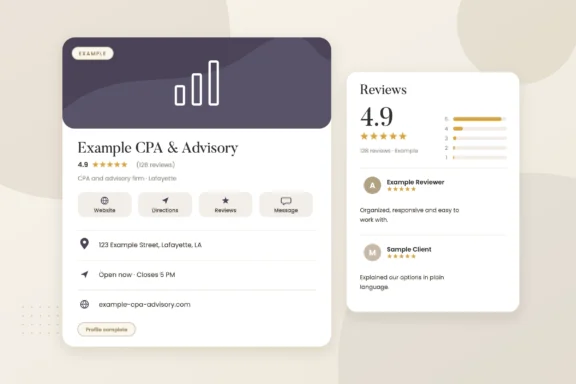
- Prominence — how well-known and trusted your business is. Google says this is shaped by things like how many websites link to you and, in its words, “how many reviews you have” and your ratings.
The important takeaway: distance is mostly fixed, relevance is a setup problem you solve once and maintain, and prominence is the part you can grow month after month. That’s where the real work — and the real ranking gains — live.
Why does a competitor outrank me when my business is closer?
This is the question I hear most from Louisiana owners, and the answer is almost always prominence plus completeness. Google doesn’t just rank the closest business — it ranks the closest business it trusts to serve the searcher well. If a competitor two towns over has 120 reviews, a fully filled-out profile, the right primary category, fresh photos, and a real website linking back to the listing, Google will often rank them above a closer business with 11 reviews and a half-finished profile.
Google states plainly that “businesses with complete and accurate info are more likely to show up in local search results.” A thin profile isn’t neutral — it actively holds you back. Before you blame distance, make sure your profile is 100% complete: correct primary category, every relevant secondary category, services written out, hours (including holiday hours), a real description, and photos added regularly.
How much do Google reviews affect your Maps ranking in Louisiana?
A lot — and more every year. Reviews feed prominence directly, and they’re also what convinces a searcher to pick you once you show up. According to BrightLocal’s 2026 Local Consumer Review Survey, 97% of consumers read online reviews for local businesses, 85% are more likely to use a business after reading positive reviews, and 71% use Google to read those reviews — more than any other platform.
Two numbers matter most for Louisiana businesses trying to climb:
- Recency. 74% of consumers say they only care about reviews written in the last three months. A pile of five-star reviews from 2023 doesn’t carry the weight it used to. You need a steady drip, not one big push.
- Volume and rating floor. 47% of consumers won’t use a business with fewer than 20 reviews, and 68% require at least a 4-star average. If you’re sitting at 8 reviews, getting to 25–30 recent ones is often the single highest-impact move you can make.
Responding matters too: 80% of consumers are more likely to use a business that replies to all its reviews, and 89% expect a response. Reply to every review — good and bad — and work keywords and your city in naturally (“Thanks for trusting our Lafayette team with your roof”). If reviews are your weak spot, start with our guide on how to get more Google reviews in Louisiana and our reputation and reviews system.
What’s the fastest way to move into the Louisiana map pack?
The “map pack” is the block of three businesses Google shows above the regular results. That’s the real prize — it’s where the clicks and calls concentrate. Here’s the order I’d work in to get there:
- Complete and verify your Google Business Profile. Fill every field. Choose the most specific primary category (not “contractor” when “roofing contractor” exists), then add relevant secondary categories.
- Nail your name, address, and phone (NAP) everywhere. Your business name, address, and phone must match exactly across your website, Google, Yelp, Facebook, and every directory. Inconsistent NAP quietly drags down trust.
- Build a recent-review habit. Ask every happy customer, every time, with a direct link. Aim to out-pace your nearest competitor’s review velocity and recency — not just their total.
- Add photos and posts regularly. Fresh photos of real jobs, your team, and your location signal an active business. Google Business Profile posts keep the listing current.
- Strengthen the website behind the profile. A fast, local, well-structured site with city and service pages gives Google the relevance and prominence signals that lift the whole profile.
Steps 1, 2, and 4 are the core of Google Business Profile management, and the whole system is what we mean when we talk about local SEO — it’s not one task, it’s the profile, the reviews, the citations, and the site working together.
How long does it take to rank higher on Google Maps?
Expect meaningful movement in roughly 2–4 months of consistent work, not days. A brand-new or badly neglected profile can see early gains within a few weeks once it’s completed and verified, because you’re closing an obvious gap. But climbing into a competitive map pack — think “personal injury lawyer Houma” or “roofer Lafayette” — takes sustained reviews, citations, and content, because you’re overtaking businesses that have been building prominence for years.
The businesses that win are the ones that treat it as a habit: a few new reviews every week, photos added monthly, NAP kept clean, and the website maintained. The good news is that this compounds — and once you’re in the pack, the same habits are what keep you there.
Do you need a website to rank on Google Maps?
Yes — practically speaking, you do. You can technically appear on Maps with just a Business Profile, but Google ties prominence partly to the links and signals pointing at your business, and your website is the anchor for all of it. A real site lets you build city and service pages (which feed relevance), earn links (which feed prominence), and give visitors somewhere to convert after they find you. We walk through this in our breakdown of whether Louisiana businesses still need a website in 2026. Short version: the profile gets you seen; the website helps you rank and turns the attention into booked work.
Frequently asked questions
Can I pay Google to rank higher on Google Maps?
No. Google states clearly that “there’s no way to request or pay for a better local ranking.” You can run Google Local Services Ads or Google Ads to appear in paid placements, but those are separate from the organic map pack. Organic Maps ranking is earned through relevance, distance, and prominence — a complete profile, consistent information, reviews, and a strong website. Anyone promising to buy your way to the top of the map pack doesn’t understand how it works.
What’s the single most important factor for ranking on Google Maps?
For most Louisiana businesses, it’s reviews — specifically recent, positive ones in volume. Reviews feed Google’s “prominence” factor and are the thing searchers weigh most heavily once you appear. With 74% of consumers only caring about reviews from the last three months, a steady habit of asking beats one big burst. That said, reviews only help once your profile is complete and your category is right, so fix those first, then make reviews your ongoing focus.
How many Google reviews do I need to rank in Louisiana?
There’s no fixed number — it’s relative to your competitors. The goal is to out-pace the nearest businesses in your town for both total reviews and recency. As a practical floor, 47% of consumers won’t use a business with fewer than 20 reviews, so getting to 20–30 recent reviews is a strong early target. In competitive markets like Lafayette or Houma, the map-pack leaders often have 50–150+, so plan for an ongoing habit, not a finish line.
Does my business address have to be public to rank on Maps?
Not always. Service-area businesses that go to customers (like contractors or mobile services) can hide their street address and still rank by setting defined service areas. Businesses customers visit (clinics, offices, storefronts) should show a verified address. Either way, consistency is what matters: whatever address or service area you use, keep it identical everywhere Google and other sites display your business.
Why did my Google Maps ranking suddenly drop?
Common causes include a competitor adding reviews faster than you, inconsistent or changed NAP information, a profile edit that got flagged, a suspension, or a broader Google update. Start by confirming your profile is still verified and your information is accurate, then check whether a competitor’s review count or activity jumped. Rankings also fluctuate normally day to day, so look at a two-to-four-week trend rather than a single day before assuming something broke.
Want to know exactly why you’re ranking where you are?
If you’re not sure which of these signals is holding you back, that’s the thing to find out first. We offer a free visibility audit that shows where you stand on Google Maps and search against your nearest Louisiana competitors, and what to fix in what order — no obligation. You can request your free 48-hour visibility audit or book a strategy call whenever it’s helpful.
About the author: Kayce Sadler is the Founder & CEO of Abode Marketing, a Louisiana-based agency that helps law firms and local service businesses rank in the Google map pack, earn more reviews, and get found in AI search. She works hands-on with Acadiana and Gulf Coast businesses on local SEO, Google Business Profile optimization, and reputation growth. Connect with her on LinkedIn.
Sources: Google — Improve your local ranking on Google; BrightLocal 2026 Local Consumer Review Survey; BrightLocal Local SEO Statistics 2026.