The Lafayette Medical Clinic Marketing Playbook: How to Show Up When Patients Search

Most Lafayette medical clinic owners I talk to are not under-marketed. They are mis-marketed. The website is built like a brochure. The Google Business Profile has not been touched since the receptionist set it up. New-patient inquiries are coming mostly from referrals, and the practice has no real channel from search.
Meanwhile, the hospital system 3 miles away is ranking for every condition, every procedure, every “near me” search in the parish. Not because they are better at marketing — because they have built the foundation that medical search rewards.
What Medical Search Actually Looks Like in 2026
A patient in Lafayette does not search “primary care doctor.” They search “primary care Lafayette,” “pediatrician Lafayette accepting new patients,” “back pain doctor Lafayette,” or — increasingly — they ask ChatGPT or Google AI “what is the best primary care clinic in Lafayette LA.” All three search types are pulling from the same kind of data: structured, local-anchored, condition-specific content that signals “real practice, real location, real expertise.”
Most Louisiana clinic websites have none of that. They have a Home, About, Services, Contact structure. Services lists 14 things in a paragraph. That is invisible to medical search.
The Three-Layer Medical Marketing Foundation
Layer 1: Condition pages tied to your market
A Lafayette medical clinic that wants to attract chronic back pain patients needs a page for “Back pain treatment Lafayette.” A Baton Rouge clinic wanting pediatric volume needs “Pediatric care Baton Rouge.” Each page talks about the condition, the treatment approach, what the patient experience looks like, and the location served.
This is the single highest-leverage thing a Louisiana clinic can do. Most have zero. The clinics that have 8-12 of them dominate.
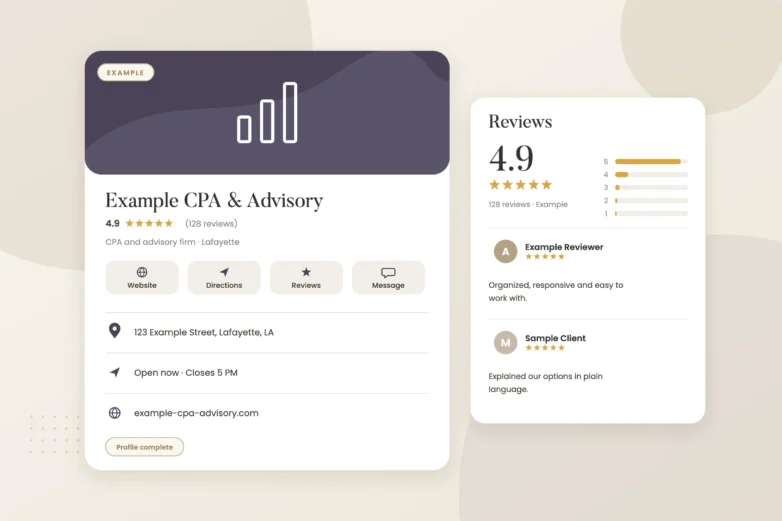
Layer 2: A Google Business Profile that does not look abandoned
Real photos of the clinic, not stock. Weekly posts about practice updates, condition information, seasonal health topics. Services tagged properly. Q&A populated. Reviews responded to within 48 hours. This sounds basic. Most Lafayette medical clinics are not doing any of it.
Layer 3: Reviews systematically collected from real patients
HIPAA-conscious review collection is doable. A simple post-visit email or text asking happy patients to share their experience publicly, with a one-tap link. Volume of recent reviews is one of the strongest local search signals for medical search, and almost no Louisiana clinic is collecting them systematically.
What Hospital Systems Have That You Can Replicate
Hospital systems win because they have content depth and consistent local signals across hundreds of pages. You do not need hundreds. You need 12-20 high-quality, condition-and-location-specific pages, an active Google Business Profile, and a consistent review pipeline. That stack is enough to beat hospital systems in your own market for the searches that actually matter.
What Does Not Work
Buying directory listings on Healthgrades or Zocdoc as a primary strategy. Running Facebook ads to broad audiences without regard for the AMA Code of Medical Ethics on physician advertising. Posting once a quarter to your GBP. Hiring a generic SEO agency that wants to put backlinks from random blogs onto your site. Medical advertisers are also subject to FTC Health Products Compliance guidance on substantiating claims. All of these approaches are wasted money in 2026.
What works is unglamorous, repeatable, and built on real local signals.
Find Out Where Your Clinic Actually Stands
The free visibility audit gives you a 15-page written analysis of how your medical practice shows up in Google search, Google Maps, AI search, and against the other clinics in your Louisiana market. Real data, no sales call required.
Get Your Free Visibility Audit →
Why Lafayette Clinics Can Beat the Hospital Systems
In Lafayette, the hospital systems — the Ochsner Lafayette General and Our Lady of Lourdes networks — rank for nearly everything because they have hundreds of pages and consistent local signals. But that scale is also their weakness. Their marketing is run by a corporate team that does not customize at the clinic level, and their Google Business Profiles are often set up once and left alone. An independent clinic that commits to medical practice marketing done right — 12 to 20 condition-and-location pages, an active profile, and a real review pipeline — can out-rank a hospital system for the searches that actually bring in new patients in its own neighborhood.
We have seen this play out. Our Apex Spine and Pain Center case study went from zero walk-ins to a steady stream of new-patient inquiries by building exactly this foundation. The coverage and telehealth expectations for Louisiana clinics in 2026 only raise the stakes — patients now research, compare, and often ask AI before they ever call. Getting the local SEO foundation right is what puts your clinic in that consideration set.
Frequently Asked Questions
How do independent Lafayette clinics compete with hospital systems on Google?
You do not need to match their hundreds of pages — you need 12 to 20 high-quality, condition-and-location-specific pages, an active Google Business Profile, and a consistent review pipeline. That stack is enough to beat a hospital system in your own market for the searches that actually matter, because their corporate marketing does not customize at the clinic level.
What is medical SEO and why do condition pages matter?
Medical SEO is structuring your website and local profiles so patients find you when they search for the care they need. Condition pages — “back pain treatment Lafayette,” “pediatric care Baton Rouge” — matter because patients search by symptom and city, not “primary care doctor.” Each page connects a specific patient need to your practice and location.
Is review collection HIPAA-compliant for medical practices?
Yes, when done carefully. A simple post-visit email or text inviting happy patients to share their experience publicly, with a one-tap link, is HIPAA-conscious as long as you are not disclosing protected health information. Volume of recent reviews is one of the strongest local search signals in healthcare, and almost no Louisiana clinic collects them systematically.
How many pages does a medical clinic website need?
Enough to cover the conditions and locations you want to be found for — typically 12 to 20 condition-and-location pages, not a single Services page listing 14 items in a paragraph. The clinics that have 8 to 12 well-built condition pages consistently dominate local medical search. A free medical practice audit shows you the gaps.
How long does medical practice marketing take to work?
With the three-layer foundation in place — condition pages, an active Google Business Profile, and a review pipeline — most clinics see meaningful movement within one to two quarters. Local Map Pack visibility often improves first. Want a plan for your practice? Book a strategy call.