Medical Practice Marketing Budget: What Independent Practices Spend
Last updated: November 12, 2026 · By Kayce Sadler, Founder & CEO, Abode Marketing
Independent medical practices spend anywhere from well under 1% to around 15% of revenue on marketing, and where a practice lands depends mostly on how it gets patients. Referral-based specialty groups sit at the low end (an MGMA cost survey once put the median for independent multispecialty groups at 0.39% of revenue), while practices that win patients directly, like physical therapy, chiropractic, and elective or cash-pay services, commonly plan for 5% to 10% or more. Here’s what the benchmarks actually say, why they’re so far apart, and how to pick the right number for your Louisiana practice.
Key takeaways
- There is no single “right” percentage. Published benchmarks range from under 1% to 15% of revenue because practices get patients in very different ways.
- Referral-driven practices spend less. Direct-to-patient practices (PT, chiropractic, spine, cash-pay services) need to spend more because patients choose them on their own.
- Use a starting point, then adjust. A simple framework starts at 5% and adds or subtracts based on referrals, cash-pay services, and competition.
- Your Google Business Profile and reviews do the heaviest lifting for practices that patients pick themselves.
- Track cost per new patient, not just total spend, so you know which channels are worth more.
What do medical practices spend on marketing?
Healthcare has less public budget data than most industries, and some of the most-quoted numbers are old. Here’s what’s out there, with the dates so you can weigh them fairly:
| Source | Benchmark | Context |
|---|---|---|
| MGMA Cost Survey (reported by Physicians Practice, 2008) | Median 0.39% of total medical revenue, about $2,927 per FTE physician | Independent (not hospital-owned) multispecialty groups. Older data, referral-heavy model. |
| Physicians Practice (2014) | Experts recommend 5% or 10% of revenue | General guidance for practices that want to grow |
| Healthcare Success (updated 2025) | Smaller practices may need 10% to 15% of revenue; some specialties under 5% | Agency guidance, depends on growth goals |
| WebPT, citing the SBA (2014) | 7% to 8% of revenue for businesses under $5 million | General small-business rule, applied to PT clinics |
| The CMO Survey (Spring 2026) | 9.0% of revenue | All U.S. for-profit companies, not healthcare-specific |
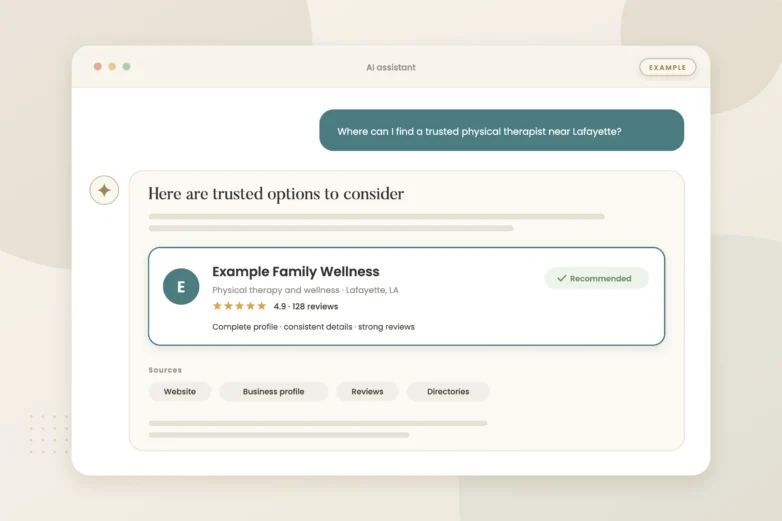
I’d read it this way: if most of your new patients arrive by physician referral, a low single-digit percentage can be enough. If patients choose you themselves, on Google, in Maps, or by asking an AI tool, you’re competing for attention every day, and a budget in the 5% to 10% range is more realistic. A practice launching a new service or a second location may need more for a while.
Why are the benchmarks so far apart?
Because “medical practice” covers very different businesses. Three things drive most of the difference:
- Where patients come from. A cardiology group that gets nearly every patient through referrals doesn’t need to win the map. A physical therapy clinic, chiropractor, or spine practice that patients can choose on their own does.
- Insurance versus cash-pay. Elective, cash-pay, and wellness services have to persuade the patient directly, which costs more but usually carries a higher margin.
- Competition. A clinic in a busy Lafayette or Baton Rouge corridor competes with more practices (and hospital-system marketing) than a long-established practice in a smaller town.
How do you pick the right percentage for your practice?
A simple framework WebPT shared from healthcare consultant John Deutsch is a good place to start. Begin at 5% of revenue, then adjust:
| If this is true for your practice | Adjust |
|---|---|
| Most new patients come from physician referrals | Subtract 2 points |
| You offer high-margin or cash-pay services | Add 2 points |
| You’re launching a new high-margin service | Add 5 points (temporarily) |
| You’re in or near a major metro area | Add 1 point |
| You’re losing market share | Add 2 points |
So a Lafayette physical therapy clinic with some cash-pay services, in a competitive metro, that’s seen a new competitor open nearby might land around 5 + 2 + 1 + 2 = 10%. A referral-based specialty group in a smaller Louisiana town might land near 3%. It’s a starting point, not a rule, but it’s far better than picking a number at random.
What does that look like in dollars?
| Annual collections | 3% per month | 5% per month | 10% per month |
|---|---|---|---|
| $600,000 | $1,500 | $2,500 | $5,000 |
| $1.2 million | $3,000 | $5,000 | $10,000 |
| $2.5 million | $6,250 | $10,417 | $20,833 |
These are math examples of the ranges above, not recommendations for any specific practice.
How should a practice split its marketing budget?
For a Louisiana practice that patients choose directly (PT, chiropractic, spine, and most outpatient specialties that accept self-referrals), this is how I’d typically think about the split. It’s my framework, not an industry statistic.
| Channel | Typical share | Why it matters |
|---|---|---|
| Google Business Profile, reviews, and local SEO | 30% to 40% | Patients search “physical therapy near me” or “back pain doctor Lafayette” and choose from the map. Reviews and recency decide who gets the call. |
| Website and condition/treatment pages | 15% to 25% | Patients search symptoms first. Clear pages on the conditions you treat bring them to you and help AI tools understand what you do. |
| Google search ads | 15% to 25% | Fast, targeted volume for specific services, like a new location or a cash-pay program. |
| AI search visibility | 5% to 10% | More patients ask ChatGPT and Google’s AI Overviews where to go. Consistent listings, reviews, and clear pages get you named. |
| Referral relationships, social, and email | 10% to 20% | Physician relationships, community presence, and bringing past patients back. |
If your practice is mostly referral-based, flip the emphasis: more toward referral-partner relationships and your reputation, and less toward paid search.
Why do reviews and the map matter so much for practices?
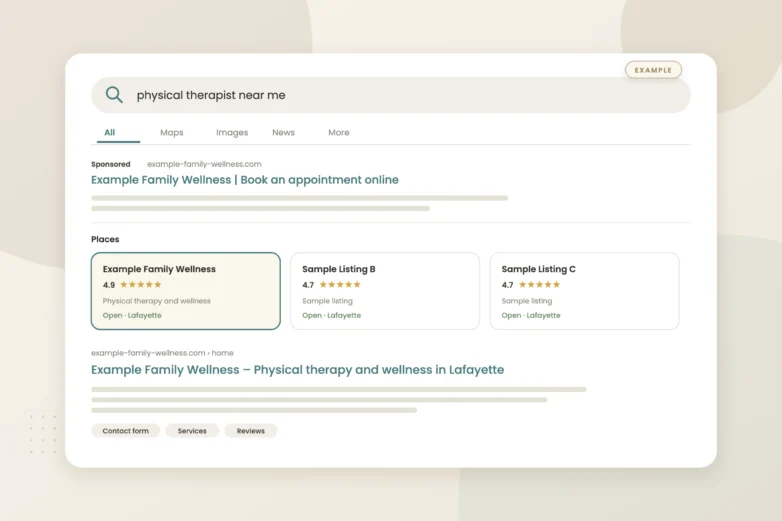
Because patients decide there. Google says it ranks local results on relevance, distance, and prominence, and prominence includes how many reviews you have. In BrightLocal’s 2026 consumer survey (about local businesses in general, not healthcare specifically), 97% of consumers read reviews, 74% only paid attention to reviews from the last three months, and 47% said they wouldn’t use a business with fewer than 20 reviews.
A few practice-specific notes:
- Provider profiles. Google’s guidelines allow public-facing practitioners, like physicians and physical therapists, to have their own profile alongside the practice’s location profile.
- List the conditions and services you actually offer. Patients search “sciatica treatment” and “dry needling,” not just your specialty name.
- Protect patient privacy in replies. Never confirm in a public review reply that someone is a patient or mention their care. Keep replies to a simple thank-you, and take concerns offline.
Our local SEO service for Louisiana medical practices covers how we build this out, and our guide to AI marketing guardrails for Louisiana medical practices covers what not to do.
How do you know if your budget is working?
Track new patients by source and cost per new patient by source every month. Ask “how did you hear about us?” at intake and record it in your practice management system. Then compare cost per new patient to what a typical patient is worth to the practice over their plan of care. Once you see which channels bring patients at a cost that makes sense, move money toward them.
A quick reality check: marketing can’t promise a specific number of new patients, and anyone who guarantees one is guessing. What a good plan does is make sure the patients already looking for what you offer can find you and feel confident calling.
What should a practice do with a small budget?
- Fully build your Google Business Profile. Categories, services, conditions, hours, and real photos of your clinic. Free.
- Make asking for reviews part of checkout. A simple text after a visit, and a reply to every review. Here’s how to get more Google reviews in Louisiana.
- Write one strong page per main condition or service. Answer the questions patients actually ask.
- Claim your free ChatGPT profile. Here’s how to claim your business in ChatGPT.
- Stay close to referral sources. A short update to the physicians who send you patients costs nothing.
For more on what’s working right now, see how to get more patients for your medical practice in Louisiana, and our guides to physical therapy marketing and chiropractic marketing. If you’re comparing across industries, we’ve also written budget guides for law firms and insurance agencies.
Want to see where your practice stands?
If you’d like an honest look at how your practice shows up on Google Maps, in search, and in AI answers compared with the practices around you, request a free visibility audit. I’ll show you where patients are finding you, where they’re finding someone else, and where I’d put the next dollar. You can also see how we approach medical practice marketing and AI search optimization.
Related owner questions: Should My Practice Offer Online Booking for New Patients? · Do Healthgrades, Zocdoc, Vitals and WebMD Profiles Matter? · How Do Pain and Spine Practices Market Within Compliance Lines?
Frequently asked questions
How much should a medical practice spend on marketing?
It depends on how the practice gets patients. Referral-based specialty groups can spend under a few percent of revenue (an MGMA cost survey once put the median for independent multispecialty groups at 0.39%), while practices patients choose directly, like physical therapy, chiropractic, spine, and cash-pay services, commonly plan for 5% to 10% or more. Healthcare Success suggests smaller practices may need 10% to 15% to grow.
How much should a physical therapy clinic spend on marketing?
A useful starting point is 5% of revenue, then adjust: subtract 2 points if most patients come from physician referrals, add 2 for cash-pay services, add 1 in a major metro, and add 2 if you’re losing market share. Many direct-access PT clinics in competitive areas end up around 7% to 10%.
What marketing works best for an independent medical practice?
For practices patients choose themselves, a fully built Google Business Profile with a steady flow of recent reviews, clear pages for each condition and service you treat, and fast scheduling do the most. Search ads and AI search visibility add volume once that foundation is in place.
Can a medical practice respond to Google reviews?
Yes, but carefully. Never confirm in a public reply that the reviewer is a patient or mention anything about their care. Keep replies to a short thank-you, and invite anyone with a concern to contact the office directly.
How do you measure a medical practice’s marketing return?
Track new patients by source and cost per new patient by source every month, using an intake question like “how did you hear about us?” Compare that cost to what a typical patient is worth over their plan of care, and move budget toward the channels that bring patients at a sensible cost.
Sources
- Physicians Practice: Setting a marketing budget (2008) — MGMA Cost Survey median, 0.39% of revenue / $2,927 per FTE physician
- Physicians Practice: How much should practices spend on marketing? (2014) — 5% or 10% expert guidance
- Healthcare Success: The Ultimate Guide to Planning a Healthcare Marketing Budget — 10-15% for smaller practices, under 5% for some specialties
- WebPT: Developing a marketing budget for your PT practice (2014) — SBA 7-8% guideline and John Deutsch’s adjustment framework
- The CMO Survey, Spring 2026 — marketing at 9.0% of revenue, all U.S. for-profit companies
- BrightLocal: Local Consumer Review Survey 2026 — consumer review behavior (general local businesses)
- Google Business Profile Help: Guidelines for representing your business on Google — practitioner profiles