Why Are Patients Choosing the Clinic Down the Street Instead of Mine?
Last updated: November 12, 2026 · By Kayce Sadler, Founder & CEO, Abode Marketing
Most of the time it isn’t your care. It’s what a patient sees in the 60 seconds before they call: your star rating and how recent your reviews are, whether you clearly take their insurance, how fast they can get in, and what Google or ChatGPT says about you. The clinic down the street usually just looks easier and safer from a phone screen.
Key takeaways
- In rater8’s April 2026 survey of 992 U.S. patients, 75% said they won’t book a provider rated below 4.0 stars and 55% had canceled or avoided booking because of reviews.
- BrightLocal’s 2026 consumer survey found 74% only consider reviews written in the last three months, so a big but stale review count can lose to a smaller, fresher one.
- 47% of patients in the rater8 survey have used AI tools to research providers, and two-thirds of those users ran into incorrect provider information.
- Zocdoc’s 2025 booking data showed 43% of appointments were booked outside traditional office hours. If you can only be reached by phone 8 to 5, some patients never reach you.
- You can see what patients see in about 20 minutes: search like a patient on your phone, write down the three clinics in the map pack, and compare them line by line.
What are patients actually comparing before they pick a clinic?
They’re comparing a short list of things they can see without calling anyone. The most useful recent data I’ve found is rater8’s 2026 Patient Choice Report, a survey of 992 U.S. adult patients fielded in April 2026. rater8 sells reputation software, so read it as a vendor survey.
In that survey, 55% of patients start with a “specialty near me” search, and 23% of first searches combine the specialty with their insurance. 43% said an insurer’s website or portal influenced which doctor they chose. 75% won’t book a provider rated below 4.0 stars, and 44% won’t book below 4.5. And 55% said they had canceled or avoided booking because of what they read in reviews, up from 40% the year before.
Here’s my take: none of that measures your clinical skill. It measures whether you look like a safe, easy choice on a small screen.
Do review count and recency matter more than my overall rating?
They work together, and recency is the one owners underestimate. BrightLocal’s Local Consumer Review Survey 2026 (1,002 U.S. adults, published February 2026) found 74% of consumers only consider reviews from the last three months, and 47% won’t use a business with fewer than 20 reviews. It covers all local businesses, not just healthcare.
So a clinic with 150 reviews where the newest one is from spring can look worse than a clinic with 60 reviews and three from last week. Google says the same thing from its side: “More reviews and positive ratings can help your business’s local ranking,” and replying to reviews shows you value feedback. In the rater8 survey, 66% of patients said seeing a provider’s review responses affects their trust.
If your reviews have slowed down, the fix is a steady, every-patient ask, not a one-time push. Our guide on getting more Google reviews in Louisiana walks through how to set that up without breaking any rules.
Are patients really asking ChatGPT which clinic to go to?
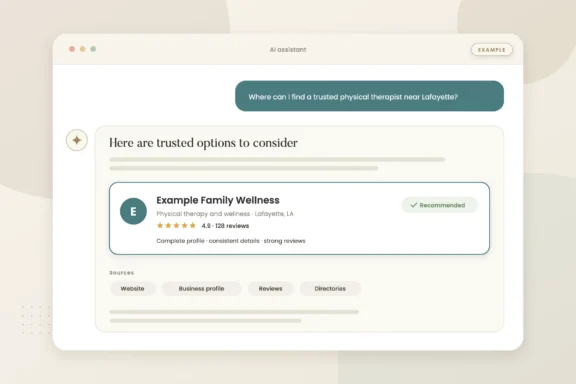
A growing share are. rater8 found 47% of patients have used AI to research providers, up from 31% in 2025, and use was highest among patients aged 45 to 60. BrightLocal’s survey shows AI tools like ChatGPT jumped from 6% to 45% as a source consumers use to check out local businesses.
The catch: among rater8’s AI users, 66% said they had come across incorrect provider information, and 60% had trusted an AI summary without double-checking it. If ChatGPT has your old address, the wrong hours, or says you don’t take a plan you do take, the patient may never find out it’s wrong. They just go somewhere else. We cover how to claim and fill out your listing in our post on the ChatGPT business profile.
Does it matter if patients can’t book online or after hours?
For a lot of patients, yes. Zocdoc’s look at its own 2025 booking data found 43% of appointments were booked outside traditional office hours, more than half were booked within four days of the patient deciding they needed care, and 22% were booked for the next day. Patients compared an average of 21 provider profiles before booking. That’s one platform’s own data, so it leans toward online bookers.
Picture the patient who hurts her back Saturday and searches at 9 p.m. One clinic has a request form and lists its plans. Yours has a phone number and voicemail.
Could my Google Business Profile alone be costing me patients?
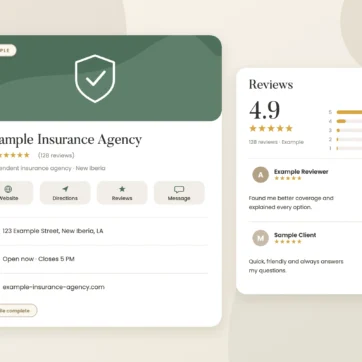
It can. Google ranks local results on relevance, distance, and prominence, and its own help page says “businesses with complete and accurate info are more likely to show up in local search results.” A profile with the wrong primary category, no services listed, missing holiday hours, or only a logo for photos is giving up ground before the patient reads a word.
Insurance accuracy is a quieter problem. rater8’s report cites a 2024 study in BMC Health Services Research that found physician addresses matched across insurer directories only 17% to 28% of the time. If your Blue Cross or Humana directory listing is wrong, the patient who starts at the insurer portal may land on the clinic down the street instead. For how the three map spots get decided, see how the Google map pack works.
How can I see my clinic the way a patient does in 20 minutes?
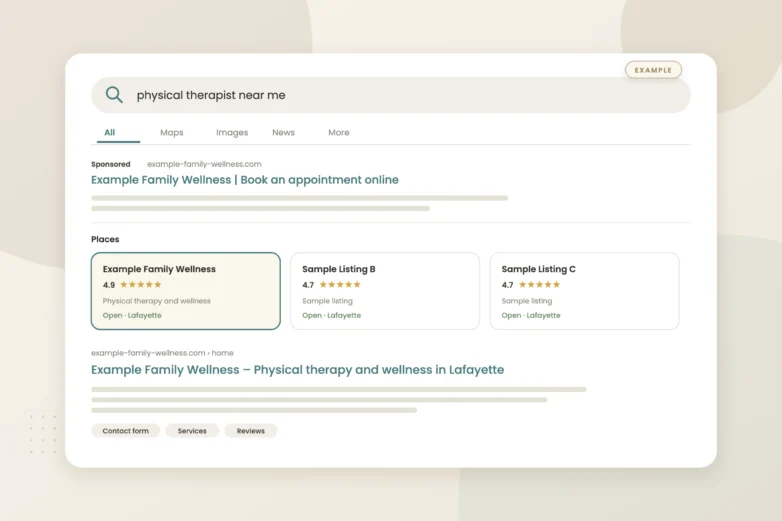
Grab your phone, open a private browser window, and search the way a new patient would: “[your specialty] near me,” “[condition] doctor [your town],” and “[specialty] that takes [a plan you accept].” In Acadiana, try it from a couple of places, because someone in Broussard or Youngsville sees a different map pack than someone near River Ranch. Then fill in this table for yourself and the three clinics that show up.
| What patients compare | Where they see it | How to check yours |
|---|---|---|
| Star rating | Map pack, Google profile | Write down your rating next to the three map-pack clinics. Note anyone under 4.0 or over 4.5. |
| Review recency | “Newest” sort on Google reviews | Sort by newest. How many reviews in the last 90 days? Compare to each competitor. |
| Review count | Map pack listing | Count the gap between you and the clinic in the first spot. |
| Review responses | Under each review | Do you reply? Are replies personal, short, and free of any patient details? |
| Insurance accepted | Your website, insurer portals | Find your clinic in two insurer directories. Is the address and phone right? Does your site list plans? |
| How fast they can get in | Website, Google “Book” or website button | Can someone request an appointment at 9 p.m. on a Sunday without calling? |
| Hours and photos | Google profile | Are holiday hours set? Are there real photos of your entrance, parking, and treatment space? |
| Condition pages | Organic results, AI answers | Does your site have a page for each condition you see most, written in patient language? |
| AI answer | ChatGPT, Google AI Overview | Ask ChatGPT for a [specialty] in your city that takes your top plan. Are you named? Is anything wrong? |
What we’d check first
- Your map-pack position for three patient-style searches, run from two or three points around your service area, with rating, review count, and newest-review date for you and each of the three clinics that appear.
- Your Google Business Profile: primary category, the services list, hours including holiday hours, real photos, and verification status. Small gaps here add up.
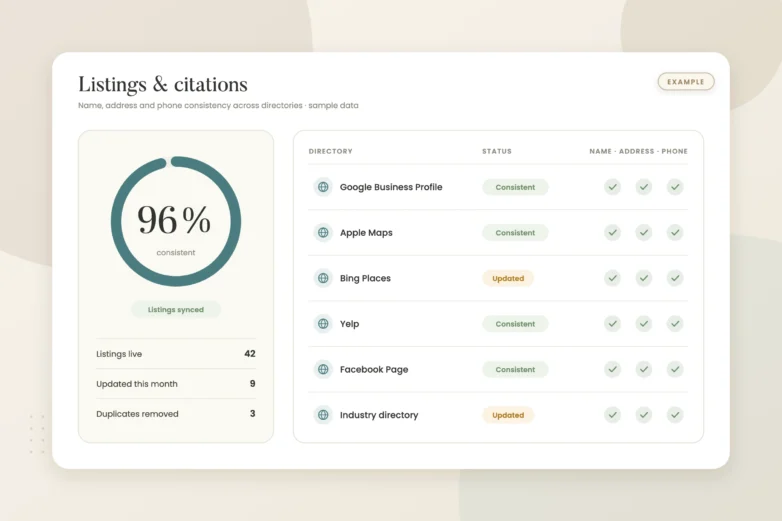
- Insurance and listing consistency: whether your name, address, and phone match on your website, insurer directories, and the big health directories patients use.
- Your website’s path to an appointment: condition pages, insurance information, mobile speed, and whether there’s a way to request a visit after hours.
- What ChatGPT and Google AI Overviews say when asked for a clinic like yours in your city, and whether you’ve claimed your ChatGPT business profile.
- Who’s bidding on your clinic’s name in Google Ads, because a patient searching for you by name can still be sent to a competitor’s ad.
For the bigger picture on bringing in new patients across Louisiana, start with how to get more patients for a medical practice in Louisiana.
If you’d like a second set of eyes, our free visibility audit runs this same comparison for your clinic: your Google profile and reviews next to the three clinics in your map pack, your listings, your website’s appointment path, and what AI tools say about you.
More owner questions we’ve answered: How Do You Market a Cash-Based Physical Therapy Practice? · Can Patients See a PT Without a Referral in Louisiana? · Should I Hire an In-House Marketer or Use a Marketing Agency?
Frequently asked questions
How many Google reviews does a medical practice need?
There’s no magic number, but BrightLocal’s 2026 survey found 47% of consumers won’t use a business with fewer than 20 reviews. What matters more in practice is how you compare to the three clinics in your map pack and whether you’re getting new reviews every month. A steady flow beats a big total that stopped growing.
Why does my clinic show up when I search but not when patients search?
Google uses distance from the person searching as one of its three local ranking factors, and your own search history can affect what you see. A patient five miles away may see a completely different map pack. Search from a private window and from a few spots around your service area to get an honest picture.
Should we list the insurance plans we accept on our website?
In most cases, yes, as long as the list is kept current. rater8’s 2026 survey found 23% of patients include insurance in their first search, and a clear, accurate list answers the question before they have to call. Add a line asking patients to confirm coverage with their plan, since networks change.
Can we offer patients a gift card for leaving a review?
Be careful. The FTC’s rule on consumer reviews bars incentives conditioned on a review saying something positive, and its guidance says you shouldn’t ask only the patients you expect to be happy. Many healthcare practices skip incentives entirely and simply ask every patient the same way, which is the simplest approach to defend.
Does a wrong listing in ChatGPT really cost patients?
It can. In rater8’s 2026 survey, 66% of patients who used AI to research providers said they ran into incorrect provider information, and 60% had trusted an AI summary without checking it. If the answer has your hours or insurance wrong, many patients won’t call to double-check.
Sources
- rater8: 2026 Patient Choice Report — Survey of 992 U.S. adult patients, April 2026: star-rating thresholds, 55% avoided booking due to reviews, 47% used AI, 66% saw incorrect AI info, insurance in first search, BMC directory study
- BrightLocal: Local Consumer Review Survey 2026 — 1,002 U.S. adults, Feb 2026: 74% only consider reviews from last three months, 47% won’t use business under 20 reviews, AI tools 45% as source
- Zocdoc: What Patients Actually Look for When Choosing a Doctor in 2026 — 2025 Zocdoc booking data: 43% booked outside office hours, more than half within four days, 22% next day, average 21 profiles compared
- Google Business Profile Help: Tips to improve your local ranking on Google — Relevance, distance, prominence; complete and accurate info; reviews help ranking
- FTC: FTC’s Endorsement Guides: What People Are Asking — Can’t condition incentives on positive reviews; don’t ask only likely-happy customers