Should I Hire an In-House Marketer or Use a Marketing Agency?
Last updated: November 12, 2026 · By Kayce Sadler, Founder & CEO, Abode Marketing
If you need one channel run deeply and have time to manage someone, a hire can work; if you need SEO, Google Business Profile, ads, reviews, web and AI search covered at once, one person rarely can. For many owner-run firms, agencies and practices, the strongest setup is a hybrid: an in-house coordinator who knows the business plus an agency for the technical work.
Key takeaways
- BLS lists a median wage of $78,760 (May 2025) for BLS occupation 13-1161 (market research and marketing roles), and $166,790 for marketing managers.
- Benefits were 28.7% of employer compensation costs in the West South Central region, which includes Louisiana, in June 2026 (BLS).
- The real cost of a hire also includes tools, training, recruiting, ramp-up and your management time.
- A hybrid model pairs an in-house coordinator with an agency, and the coordinator should hold every login.
- Always ask an agency whether it works with your competitors in the same market.
What can one marketing hire realistically cover?
One good generalist can run your calendar, your social posts, your email newsletter, event coordination, and the day-to-day relationship with whoever handles the technical work. That’s a real job, and it matters. What one person usually can’t do well, all at once, is the full stack that drives calls for a law firm, agency or practice today:
- Google Business Profile management and local SEO
- Google Ads and Local Services Ads, including conversion tracking
- Review generation and review responses
- Website development, speed, schema and landing pages
- AI search visibility in ChatGPT and Google AI Overviews
- Content writing that’s accurate for a regulated profession
- Analytics and call tracking that ties leads to cases, policies or patients
Each of those is its own discipline with its own tools. Here’s my take: if you hire one person and expect all seven, you’ll get two done well and five done sometimes, and you won’t know which five until a competitor passes you.
What does an in-house marketer really cost beyond salary?
Start with the public numbers. The Bureau of Labor Statistics’ Occupational Outlook Handbook lists a median annual wage of $78,760 in May 2025 for market research analysts, the BLS occupation group (code 13-1161) that also includes non-research marketing roles, and $166,790 for marketing managers. Local pay in Lafayette or Baton Rouge may differ, but those are the national reference points.
Salary is only part of it. BLS’s Employer Costs for Employee Compensation data for June 2026 shows benefits made up 30.0% of employer compensation costs in private industry nationally, and 28.7% in the West South Central division that includes Louisiana. Then add the costs that don’t show up on a paystub:
- Tools: SEO and rank-tracking software, design tools, a review platform, call tracking, scheduling and social tools.
- Training: Google changes its Business Profile and Ads features constantly, and AI search is moving monthly.
- Recruiting and ramp-up: the weeks of searching, interviewing and onboarding before the new hire is productive.
- Management time: yours. Someone has to set priorities, review work and know whether it’s good.
- Coverage gaps: vacations, sick days and turnover, when the work simply stops.
Ad spend is separate either way. An in-house hire doesn’t replace your Google Ads budget; it replaces the people managing it.
When does an agency make more sense?
An agency tends to fit when you need several specialties at once, when you don’t have time to manage a marketing employee, or when you’ve hired before and watched the role drift into answering phones. You’re buying a team’s skill stack and their tools, and the work doesn’t stop because one person is out.
The trade-offs are real too. An agency doesn’t sit in your staff meeting, doesn’t overhear what clients ask at the front desk, and may be working for your competitor down the street. That last one is why we only take one client per niche per market. Ask any agency directly whether they work with competitors in your area.
What does the hybrid model look like?
For a lot of owner-run firms, the answer is both: an in-house coordinator who owns the relationship and the inside knowledge, plus an agency for the technical disciplines. The coordinator gathers the photos, the client stories and the review requests, approves posts, and knows which intake calls turned into business. The agency handles the profile, the ads, the site and the search work.
This works because each side does what it’s positioned to do. The coordinator doesn’t need to be an SEO, and the agency doesn’t need to guess what’s happening in your office. It does need one rule: the coordinator, not the agency, controls the logins to your profile, website, ad account and domain.
In-house hire vs. agency vs. hybrid at a glance
| Factor | In-house hire | Agency | Hybrid |
|---|---|---|---|
| Skill coverage | Usually one or two disciplines done deeply | Several specialties across a team | Agency covers technical work; coordinator covers the inside |
| Knowledge of your business | Daily, firsthand | Depends on how often you talk | Coordinator feeds it to the agency |
| Cost structure | Salary plus benefits, tools, training, management time | Monthly fee; tools are often part of it | A smaller salary plus a narrower agency scope |
| Your management time | High, especially if you’re not a marketer | Lower, but you still review and approve | Moderate; the coordinator does the day-to-day |
| Continuity | Work stops during absences or turnover | Team covers absences | Either side can cover for the other |
| Conflict risk | None; they only work for you | May serve competitors unless they say otherwise | Same as agency; ask the question |
What should I ask before choosing either?
For a candidate: which of the seven disciplines above have you personally run, and what did you measure? Show me a Business Profile or ad account you managed. How do you stay current on Google changes?
For an agency: who will actually do the work on my account? Do you work with my competitors here? Who owns the accounts and the website if we part ways? What will you report monthly, and how does it tie to leads? Google’s own “Do you need an SEO?” page suggests similar questions, including what results to expect, in what timeframe, and how success is measured.
What we’d check first
- Who owns your accounts today. We’d check who has owner access to your Google Business Profile, website, domain and ad accounts. If a former employee or old vendor holds them, fix that before hiring anyone.
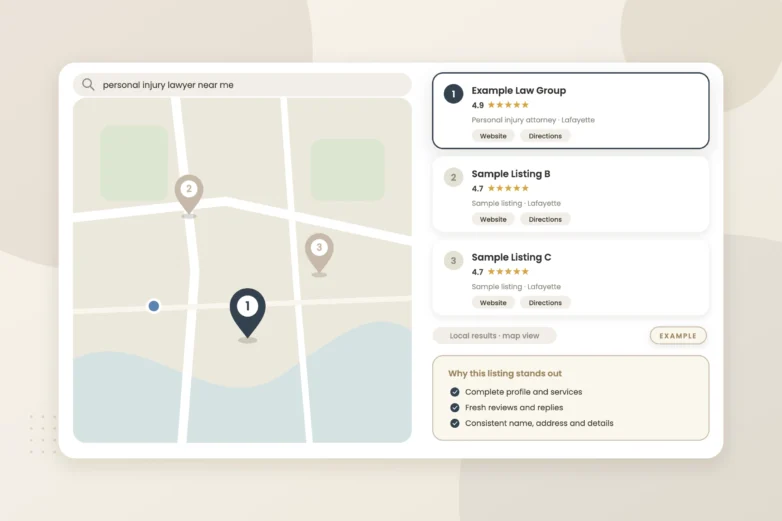
- What’s being done now, and how well. We’d look at profile completeness, review count and recency vs. the three businesses in your map pack, and your website’s service pages, to see which disciplines are covered and which are gaps.
- Whether leads are tracked. If calls and forms aren’t tied to a source, neither an employee nor an agency can prove their value, so this tells you what to fix first.
- Your AI visibility. Ask ChatGPT for a firm, agency or practice like yours in your city and see whether you’re mentioned, which shows whether anyone is working that channel.
- Who bids on your name. We’d check paid search for competitors on your brand name, a sign of how much hands-on ads work your market requires.
Related reading: what to ask before you hire marketing help in Louisiana, why we keep one client per niche, and how much a law firm should spend on marketing.
If you’re weighing a hire against an agency and want to know which gaps actually matter, our free visibility audit shows what’s covered and what isn’t across your profile, reviews, listings, website, AI answers and paid search, so you can decide with the facts in front of you.
More owner questions we’ve answered: Can My Business Rank in a City Where We Don’t Have an Office? · Why Did My Google Reviews Disappear? Causes and What to Do · How Do I Fix a Duplicate Google Business Profile?
Frequently asked questions
Can I hire a part-time or freelance marketer instead?
Yes, and for a narrow task like social posts or a newsletter it can work well. The same skill-stack question applies, though: a freelancer is still one person, so match the hire to the specific channel you need rather than expecting full coverage.
How do I evaluate a marketing hire if I’m not a marketer myself?
Judge them on outcomes you can see: calls, form fills, new reviews and where those leads came from. Ask for a monthly one-page report tied to those numbers, and consider having an outside party review their work once or twice a year.
What happens to my accounts if I leave an agency?
That depends on your agreement, which is why it’s worth settling before you sign. You should own your Google Business Profile, domain, website, ad accounts and analytics, with the agency added as a manager, so leaving never means starting over.
Is it a bad sign if an agency has many clients in my industry?
Not by itself, since industry experience is useful. The concern is whether they serve your direct competitors in the same city, which can create a conflict over the same searches and the same map pack spots. Ask the question directly.
When is the right time to switch from an agency to an in-house team?
Usually when your marketing volume is steady enough to keep a person fully busy in one discipline, and you have someone to manage them. Many firms bring one function in-house first, such as content or social, and keep the technical work with an agency.
Sources
- BLS Occupational Outlook Handbook: Market Research Analysts — Median annual wage $78,760, May 2025
- BLS OEWS: 13-1161 Market Research Analysts and Marketing Specialists — Confirms marketing specialists are in this BLS occupation group
- BLS Occupational Outlook Handbook: Advertising, Promotions, and Marketing Managers — Marketing managers median annual wage $166,790, May 2025
- BLS The Economics Daily: Compensation costs for private industry workers, June 2026 — Benefits 30.0% of employer compensation costs, private industry
- BLS: Employer Costs for Employee Compensation by region, June 2026 — West South Central (incl. Louisiana) benefits 28.7% of compensation
- Google Search Central: Do you need an SEO? — Questions to ask a prospective SEO provider