Can My Business Rank in a City Where We Don’t Have an Office?
Last updated: November 12, 2026 · By Kayce Sadler, Founder & CEO, Abode Marketing
Yes in regular search results, ads and sometimes AI answers. Rarely in the Google map pack, because Google ranks local listings partly on how far the business is from the searcher, and a virtual office isn’t eligible for a profile. The way in is real local substance on your website, paid campaigns targeted to that city, and reviews and links from people who actually live there.
Key takeaways
- Google names relevance, distance and prominence as its local ranking factors, and says there’s no way to pay for a better local ranking.
- Google’s guidelines say a rented mailing address you don’t operate from, a virtual office, isn’t eligible for a Business Profile.
- Pages that target cities and funnel users to one place are listed as doorway abuse in Google’s spam policies. City-swap pages fall into that.
- Local Services Ads and Google Ads both let you target a city with no office. Google Ads’ “Presence” option keeps ads to people actually located there.
- Louisiana Rule 7.2(a)(2) requires law firm ads to disclose a bona fide office city. A Lake Charles page can’t imply a Lake Charles office that doesn’t exist.
Every growing business hits this. You’ve got a strong reputation in Lafayette, but more calls are coming from Lake Charles or Baton Rouge, and you’d like Google to notice. You can win business in those cities online. You just can’t fake being there, and the map pack is the one place where that matters most.
Why is the map pack so hard to crack from another city?
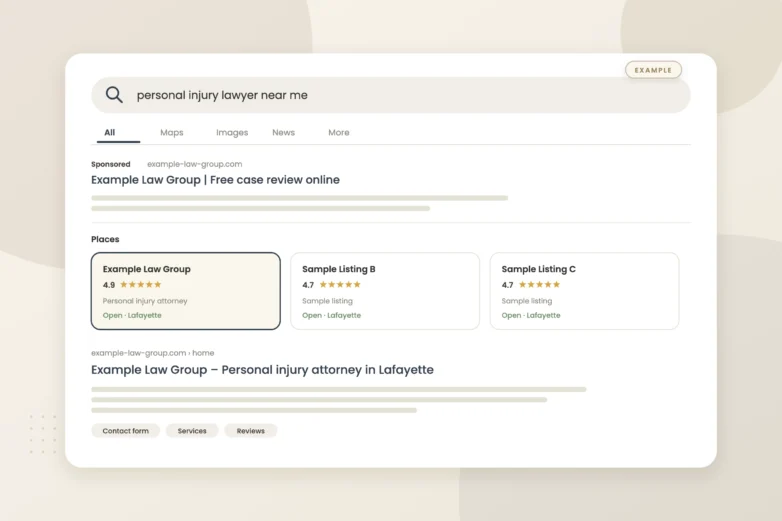
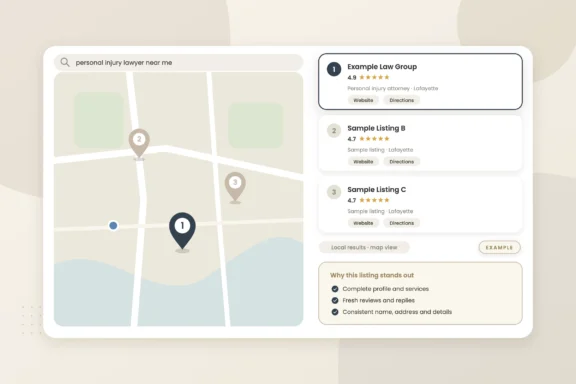
Because distance is part of the formula. Google’s help page on local ranking says results are based on relevance, distance and prominence. It defines distance as “how far each business is from the customer who’s searching.” When someone in Lake Charles searches “personal injury lawyer,” Google has dozens of qualified firms within a few miles. A firm more than an hour away has a steep hill to climb, no matter how many reviews it has.
Google is also blunt that “there’s no way to request or pay for a better local ranking.” Here’s my take. Accept the map pack as a home-turf channel, and fight for the other city everywhere else.
Can we just rent a suite or virtual office there?
Not for a Google profile. Google’s guidelines say that if “your business rents a physical mailing address but doesn’t operate out of that location,” known as a virtual office, “that location isn’t eligible for a Business Profile.” Service-area businesses also “can’t list a ‘virtual’ office unless that office is staffed during business hours.” Competitors do report listings like that, and I wouldn’t put your real profile’s standing at risk for one.
For law firms, the Louisiana bar has its own test. Rule 7.2(a)(2) defines a bona fide office as a location where the firm “reasonably expects to furnish legal services in a substantial way on a regular and continuing basis,” with at least one lawyer “regularly and routinely present.” Ads and the firm’s website have to disclose real office locations. A mailbox doesn’t meet that definition.
If you’re willing to staff a real office in the new city, that changes everything. Then it earns its own profile honestly.
Does a city page on our website still work?
Yes, if it’s a page a resident of that city would find genuinely useful. No, if it’s your Lafayette page with “Lake Charles” pasted over it. Google’s spam policies list “having multiple domain names or pages targeted at specific regions or cities that funnel users to one page” as doorway abuse. Its scaled-content rules cover mass-produced pages that provide “little to no value to users, no matter how it’s created.”
A useful city page answers what that reader actually wonders. For a Lafayette firm writing about Lake Charles, that might be:
- Whether you’ll come to them, and how meetings work across the distance: video consults, set travel days, signing documents remotely.
- Which courthouse in Calcasieu Parish their case would likely be filed in, and how often your lawyers are there.
- Where your office is, stated plainly: “Our office is in Lafayette. We represent clients throughout Calcasieu Parish.”
- Real reviews or testimonials from clients in that area, used with permission and with any required disclaimers.
I’d rather see three substantial pages for the cities you truly serve than thirty thin ones. If you can’t write something specific about a city, that’s usually a sign you don’t serve it enough to deserve a page yet.
Which channels reach a city where we have no office?
| Channel | Can it reach a city with no office? | Notes |
|---|---|---|
| Google map pack | Rarely | Distance is a core factor. You may show occasionally for searchers near the side of town closest to you. |
| Virtual-office Business Profile | No | Ineligible under Google’s guidelines. |
| Organic city pages | Yes | Only with real local substance; city-swap copies fit the doorway definition. |
| Local Services Ads | Yes | Service area is set by city, county or neighborhood. Adding a city covers people located there and people whose searches name it. |
| Google Ads search | Yes | Target the city or parish. Consider “Presence” over the default “Presence or interest” to avoid paying for out-of-area clicks. |
| Reviews from that city | Indirectly | Builds trust with local readers and gives your page real local proof. It won’t override distance. |
| Local links and sponsorships | Indirectly | A chamber membership, community sponsorship or local news mention ties your name to that city. |
| AI answers | Sometimes | Also distance-sensitive. BrightLocal found about 53 to 59% of AI picks were within 5 km of the searcher. |
How do AI answers handle businesses from out of town?
Much like the map pack, with more randomness. BrightLocal’s 2026 study of roughly 200,000 localized prompts found that about 53 to 59% of the businesses that ChatGPT and Google’s AI surfaces recommended were within 5 km of the searcher. Tracked businesses showed up in 66% of Google Maps searches but only 32 to 38% of AI searches.
So AI won’t magically erase the distance problem. What helps is the same material that makes a good city page: a website that states plainly who you serve and where, plus third-party mentions that connect your name to that city.
What we’d check first before you target a new city
- Your Business Profile setup. That your real address, categories and hours are right. Also whether anyone has added a service area or a second listing that could cause trouble.
- Your existing city pages. Whether any are near-duplicates with the city name swapped, which is the first thing we’d rewrite or remove.
- Where your clients come from. How many reviews and leads already come from that city, so the page has real experience to draw on.
- Paid coverage. Your LSA service area, Google Ads location setting (Presence versus Presence or interest), and who already bids in that market.
- AI answers there. What ChatGPT and Google’s AI Overviews say for your service in that city, and whether your ChatGPT business profile states the areas you serve.
- Local proof. Directory listings, chamber memberships and local links that tie your name to that city honestly.
Related reading: how the Google map pack works, Google Local Services Ads in Louisiana and law firm marketing in Lake Charles.
If you’re eyeing a neighboring city and want to know what’s realistic, our free visibility audit shows how you appear there today across Maps, organic search, ads and AI answers. Then we’ll tell you honestly which channels are worth it.
More owner questions we’ve answered: Why Did My Google Reviews Disappear? Causes and What to Do · How Do I Fix a Duplicate Google Business Profile? · Fake Google Review From a Former Employee or Competitor? What to Do
Frequently asked questions
Does adding a city to our Google service area make us rank there?
Not in any dependable way. A service area tells customers where you travel to serve them, but your listing’s location is still your real address. Use it to describe where you actually work, not as a ranking tactic.
Can we use a local phone number for the other city?
A tracking number on a city page or ad is fine for measuring calls. Putting a different local number on your Business Profile than on your website and listings creates inconsistency. Keep your main number on the profile.
How long does a good city page take to rank?
It depends on competition and on how much your site is already trusted, so expect months rather than weeks. A thin page may never rank at all. Paid campaigns can fill the gap while the page earns its place.
Should we open a real office in the other city?
If the case or patient volume justifies a staffed location, yes; it’s the only honest way into that city’s map pack. For a law firm, it also has to meet Louisiana’s bona fide office definition, with a lawyer regularly present. A part-time conference room usually doesn’t.
Sources
- Google Business Profile Help: Tips to improve your local ranking on Google — Relevance, distance, prominence; no way to pay for better local ranking
- Google Business Profile Help: Guidelines for representing your business on Google — Virtual offices ineligible; service-area businesses can’t list an unstaffed virtual office
- Google Search Central: Spam policies for Google web search — Doorway abuse (pages targeted at cities that funnel users) and scaled content abuse
- Google Local Services Help: About reaching customers with your Local Services Ads — Service areas by city, county, neighborhood; city covers located and city-naming searches
- Google Ads Help: About advanced location options — Presence vs. Presence or interest (default)
- BrightLocal: Local AI Visibility Study (Sept. 2026) — 53-59% of AI picks within 5 km of searcher; 66% Maps vs 32-38% AI appearance
- LSBA: Louisiana lawyer advertising rules (effective Jan. 1, 2022) — Rule 7.2(a)(2) bona fide office definition and disclosure; Rule 7.6(b) website office disclosure