Should a Personal Injury Firm Buy Leads or Build Its Own Marketing?
Last updated: November 12, 2026 · By Kayce Sadler, Founder & CEO, Abode Marketing
For most personal injury firms, I’d use bought leads as a short-term supplement and put the long-term effort into channels you own: your Google Business Profile, reviews, website, Local Services Ads and visibility in AI search. Owned channels build on themselves and keep the data with you. In Louisiana, any lead-vendor arrangement also has to fit Rule 7.2(c)(13), which bars giving anything of value to a person for recommending a lawyer. Have your ethics counsel review the vendor’s structure before you sign.
Key takeaways
- Louisiana’s line: Rule 7.2(c)(13) says a lawyer “shall not give anything of value to a person for recommending the lawyer’s services,” with exceptions for the reasonable cost of permitted advertising and qualifying non-profit or bar referral services.
- The LSBA Handbook (2nd ed., Nov. 2022) covers bar and non-profit referral services but doesn’t address for-profit lead generators by name.
- The ABA’s 2012 comment allows paying lead generators only if they don’t recommend the lawyer, imply the referral is free, or appear to analyze the person’s legal problem.
- ABA Formal Opinion 501 (2022) treated hiring a professional lead generator to find mass tort clients as improper solicitation.
- Ask every vendor: Is the lead exclusive? Where did it come from? Who keeps the data if we stop paying?
What am I actually paying for when I buy leads?
“Leads” covers a lot of different arrangements. You might pay per form fill, per phone call, per qualified call over a set length, or per signed case. Some vendors sell a lead to one firm only. Others send the same person to several firms at once, and whoever calls first usually wins. Before you compare prices, find out which one you’re actually buying.
Questions I’d ask any vendor:
- Is this lead exclusive to us, and how do you prove that?
- What ad or page did the person respond to, and what did it say about lawyers?
- Did the person agree to be contacted by a law firm, and do we get a record of that?
- If we stop paying, do we keep the call recordings, contact records and source data?
What do Louisiana’s rules say about paying for leads?
Start with the rule text, not a vendor’s sales deck. Louisiana Rule 7.2(c)(13), in the Rules of Professional Conduct, says a lawyer “shall not give anything of value to a person for recommending the lawyer’s services.” It then lists exceptions. You may pay “the reasonable cost of advertising or written or recorded communication permitted by these Rules.” You may also pay the usual charges of a referral service run by the LSBA, a local bar or another not-for-profit organization, as long as it refers everyone who asks, doesn’t let lawyers raise fees to cover the charge, and distributes referrals fairly by rotation or random allotment.
The LSBA’s Handbook on Solicitation and Lawyer Advertising (Second Edition, November 2022) adds two relevant points. A lawyer “cannot sidestep” the solicitation ban by having someone else solicit for them. And a lawyer may not pay for the advertising of a lawyer outside the firm. The Handbook doesn’t mention for-profit lead generators by name, so a vendor’s claim that it’s “bar-compliant” is something to check, not something to take on faith.
How have ethics authorities outside Louisiana handled lead generators?
The ABA added a comment to Model Rule 7.2 in 2012 allowing payment to lead generators under three conditions. The generator can’t vouch for the lawyer’s credentials, can’t suggest the referral is free, and can’t appear to have matched the person to a lawyer by analyzing their legal problem. Louisiana’s rule text doesn’t include that comment, so treat it as background, not as Louisiana law.
Two more data points. In ABA Formal Opinion 501 (April 2022), one of the hypotheticals the committee found impermissible was a lawyer hiring a professional lead generator to find mass tort clients. It also said a lawyer who knowingly assists or authorizes someone else’s improper solicitation violates the rules. And New York’s NYSBA Opinion 1131 (2017) approved a flat marketing fee for leads partly because the fee didn’t change based on whether the person hired the lawyer.
Is “pay only for signed cases” a problem?
That last point is why this model deserves a closer look. If a vendor or agency only gets paid when a client signs, the payment starts to look less like an advertising cost and more like paying for a recommendation, or sharing a fee. Louisiana Rule 5.4 limits sharing legal fees with nonlawyers. I’m not your lawyer and this isn’t legal advice. If someone offers you results-only pricing tied to signed cases, take the contract to the LSBA’s Ethics Counsel or your own ethics lawyer before you agree to anything.
Don’t forget filing. Rule 7.2(c)(1) covers communications a lawyer makes “or permit[s] to be made,” so ads a vendor runs naming your firm are worth treating as your own. Non-exempt ads have to be filed under Rule 7.7. Ask Ethics Counsel how that applies to a specific vendor.
What does owned marketing give me that bought leads don’t?
Owned channels keep working after you stop paying for them. Reviews, a well-built Google Business Profile and strong practice pages keep producing calls. Every caller comes to your firm directly, and the data stays in your systems. Local Services Ads are paid, but the lead is yours alone. With direct business search, Google says your ad is the only LSA shown when someone searches your name, and it screens out returning clients so you aren’t charged for them.
The tradeoff is time. Owned channels take months to build. Leads can start next week. That’s why I’d run them side by side for a while, measured honestly against each other.
| Shared bought leads | Exclusive bought leads | Local Services Ads | Owned (GBP, reviews, site, AI search) | |
|---|---|---|---|---|
| Control over the message | Low; the vendor writes the ads | Low to medium | Medium; Google’s format and your profile | High |
| Your compliance work | Heaviest: vet structure under Rule 7.2(c)(13), check vendor ads | Heavy: same review of structure and wording | Moderate: your profile content and filings | Moderate: your own ads and website content |
| Who has the data | Vendor, and other firms who bought the same lead | Mostly the vendor; depends on contract | You, through the lead inbox | You |
| When you stop paying | Leads stop right away | Leads stop right away | Leads stop; reviews and profile stay | Keeps working, though it slowly fades without upkeep |
| How fast it starts | Days | Days to weeks | Weeks, after screening | Months |
What we’d check first
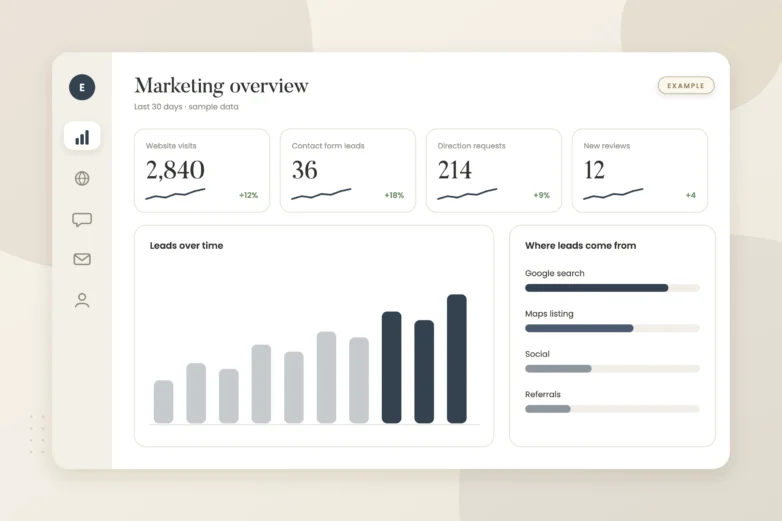
- Where your signed cases come from now. We’d look at source tags in your case management system. If you can’t split signed cases by channel, that’s the first thing to fix.
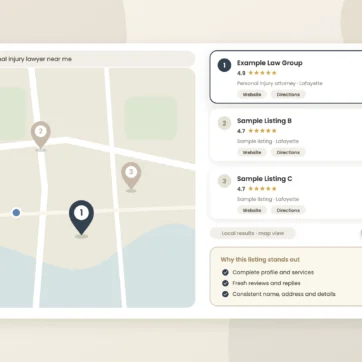
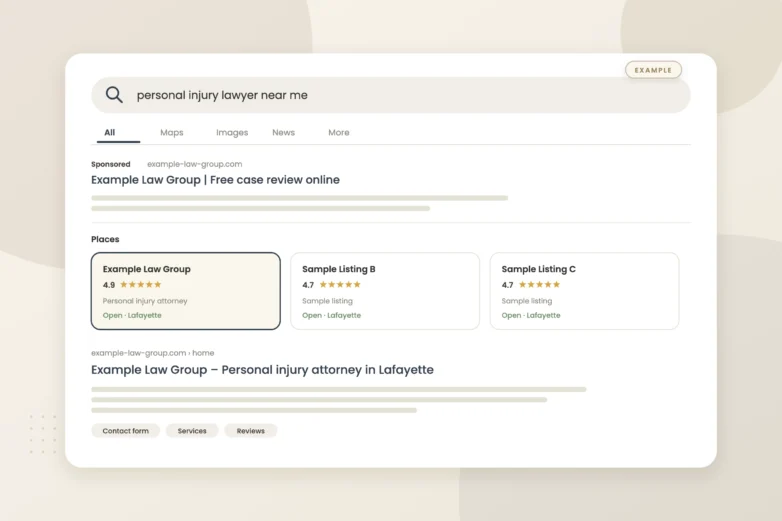
- Your map pack position in each parish you serve. We’d compare your Google Business Profile and reviews (count, rating, how recent) with the three firms showing for “car accident lawyer” there.
- LSA status. Are you screened and running? Is direct business search on? Are leads getting answered?
- Who bids on your brand. We’d check whether lead vendors or directories are showing up when people search your firm’s name.
- AI answers. We’d see what ChatGPT and Google’s AI Overviews recommend when someone asks for an injury lawyer in your city, and whether your ChatGPT business profile is claimed.
Related reading: our personal injury marketing page, an honest look at Local Services Ads for Louisiana firms, and why we work with one client per niche in a market. That last one is our version of exclusivity.
If you’d like a second set of eyes, our free visibility audit shows what your owned channels look like today: your profile, your reviews compared with the map pack, your website, your LSA status and your AI visibility. It’s a fair starting point for deciding how much to keep buying.
More owner questions we’ve answered: Are Avvo, Justia, FindLaw and Super Lawyers Profiles Still Worth It in 2026? · Can a Louisiana Law Firm Ask Clients for Google Reviews? · Fake Google Review From a Former Employee or Competitor? What to Do
Frequently asked questions
Are lead vendors’ ads my responsibility under Louisiana rules?
Often, yes. If an ad promotes your firm, you’re responsible for making sure it complies, and the LSBA Handbook says a lawyer can’t avoid the solicitation rules by having someone else do the soliciting. Ask the vendor for copies of every ad that sends leads to you.
Is a bar lawyer referral service the same as buying leads?
No. Louisiana Rule 7.2(c)(13) specifically allows paying the usual charges of a referral service run by the LSBA, a local bar or another not-for-profit, if it meets the rule’s conditions. A for-profit lead seller doesn’t fit that exception just by calling itself a referral service.
How should I compare a lead vendor with my own marketing?
Use cost per signed case and average case value, measured over the same period with the same intake process. Make sure leads from every source are tagged consistently. Otherwise, whichever channel your intake team answers fastest will look like the winner.
Can I buy leads and still build my own marketing?
Yes, and many firms do both while their owned channels build up. The danger is relying on bought leads for so long that the profile, reviews and website never get attention. Set a date to look again at what each channel is bringing in.
Do bought leads help my Google rankings?
Not directly. A lead vendor’s ads and pages build up the vendor’s visibility, not yours. Your rankings in the map pack come from your own profile, reviews and website.
Sources
- Louisiana Attorney Disciplinary Board: Louisiana Rules of Professional Conduct — Rule 7.2(c)(13) text and exceptions; Rule 5.4 fee sharing; Rule 7.7 filing
- LSBA: Handbook on Solicitation and Lawyer Advertising in Louisiana (2nd ed., Nov. 2022) — Can’t sidestep solicitation via others; referral services limited to bar/non-profit; no paying for outside lawyers’ ads
- ABA Journal: Online marketing, including lead generation, addressed in ABA ethics rules (Aug. 2012) — Model Rule 7.2 lead-generator comment conditions
- ABA Journal: ABA Formal Opinion 501 on solicitation (Apr. 2022) — Mass tort lead-generator hypothetical impermissible; Rule 8.4(a) knowing assistance
- Summary of NYSBA Ethics Opinion 1131 (2017): Paying a for-profit lead generation service — Flat fee not tied to retention; no recommendation
- Local Services Help: About direct business search — Sole LSA on brand searches; returning customers not charged