How Much Should an Insurance Agency Spend on Marketing?
Last updated: November 12, 2026 · By Kayce Sadler, Founder & CEO, Abode Marketing
The best current benchmark for independent insurance agencies comes from the Big “I” 2026 Agency Universe Study: marketing now averages 11% of total agency expenses, up from 8% in 2024, and the average agency marketing budget rose from $14,300 to $20,600. For comparison, the 2026 CMO Survey found U.S. companies overall spend about 9% of revenue on marketing. If you run an independent agency in Louisiana, use those numbers as a guardrail, then size your budget around what a new household is worth to you over the years it stays on the books.
Key takeaways
- Agencies are spending more on marketing. The Big I’s 2026 study shows marketing’s share of agency expenses rising from 8% to 11% in two years.
- Don’t count on carrier money. The same study found 78% of small agencies got zero carrier marketing support in 2025, and only 39% of agencies overall got any.
- Budget from household lifetime value, not from a monthly number that “feels right.” Retention makes each new household worth far more than its first-year commission.
- Your Google Business Profile and reviews come first. They’re where local insurance shoppers decide who to call, and they feed AI answers too.
- Louisiana shoppers are comparing harder than ever, which rewards agencies that show up first and explain things clearly.
What do independent insurance agencies actually spend on marketing?
Most “how much should I spend” articles quote a generic small-business rule. Insurance has better data than that. Here are the numbers worth knowing:
| Source | Finding | What it measures |
|---|---|---|
| Big I Agency Universe Study, ACT report (2026) | 11% of total agency expenditures go to marketing, up from 8% in 2024 | Share of agency expenses, not revenue. 1,376 agencies surveyed in spring 2026. |
| Big I Agency Universe Study, ACT report (2026) | Average agency marketing budget rose from $14,300 to $20,600 | Annual dollars, across agencies of all sizes |
| Big I Agency Universe Study, ACT report (2026) | 78% of small agencies got zero carrier marketing support in 2025 | Only 39% of agencies overall received any |
| The CMO Survey (Spring 2026) | Marketing at 9.0% of revenue | All U.S. for-profit companies, not insurance-specific |
One note on reading these: the Big I figure is a share of expenses, and the CMO Survey figure is a share of revenue. They aren’t the same measure, but they point the same direction. Agencies that are growing are putting a bigger slice of their money into getting found.
How much should your agency spend?
The average is a starting point, not a target. Three questions decide where you should land:
- Are you maintaining or growing? An agency happy with its book can spend near the average and focus on retention. An agency trying to add producers or open a new office should plan above it.
- How competitive is your market? A Lafayette or Baton Rouge agency competing with captive offices on every corner needs more visibility than a long-established agency in a small town where everyone already knows you.
- What is a new household worth? This is the one most agencies skip, and it changes everything.
How do you budget from household lifetime value?
Insurance is a renewal business, which means a new household is worth far more than its first-year commission. Here’s the simple math, with an example you should replace with your own numbers:
- Average annual commission per household: say $600 across home and auto.
- Average years a household stays: say 6.
- Lifetime commission: $600 × 6 = $3,600.
Now decide what share of that lifetime value you’re comfortable spending to win a household. If it’s 20%, you can afford about $720 to acquire one. If your marketing produces quotes at $60 each and you close one in four, each new household costs $240, and you have room to spend more. If it costs $900, you need to fix your quote-to-close process or your channel mix before adding budget.
That last step is where most of the money is. Faster follow-up, a clear quote form, and a person who calls back the same day often do more for cost per household than any new ad.
How should an insurance agency split its marketing budget?
Here’s how I’d typically think about the split for a Louisiana independent agency that wants to grow. It’s my framework, not an industry statistic, and every agency’s mix will look a little different.
| Channel | Typical share | Why it matters for an agency |
|---|---|---|
| Google Business Profile and reviews | 15% to 25% | “Insurance agency near me” is decided on the map. Reviews and recency are what make shoppers call you over the office down the street. |
| Website and local SEO | 20% to 30% | Pages for each line you write (home, auto, flood, commercial, life) and each town you serve, plus a quote form that works on a phone. |
| AI search visibility | 5% to 15% | Shoppers increasingly ask ChatGPT and Google’s AI Overviews who to call. Clear pages, consistent listings, and reviews are how you get named. |
| Google search ads | 20% to 30% | Fast, controllable quote volume during rate-change season and after storms. |
| Social, email, and community | 10% to 20% | Retention, cross-selling, and referrals from the book you already have. |
If you’re starting from scratch, fund the first two rows before anything else. Ads pointed at a thin profile with 12 reviews just send shoppers to compare you with someone who looks more established.
Why does the Google Business Profile matter so much for agencies?
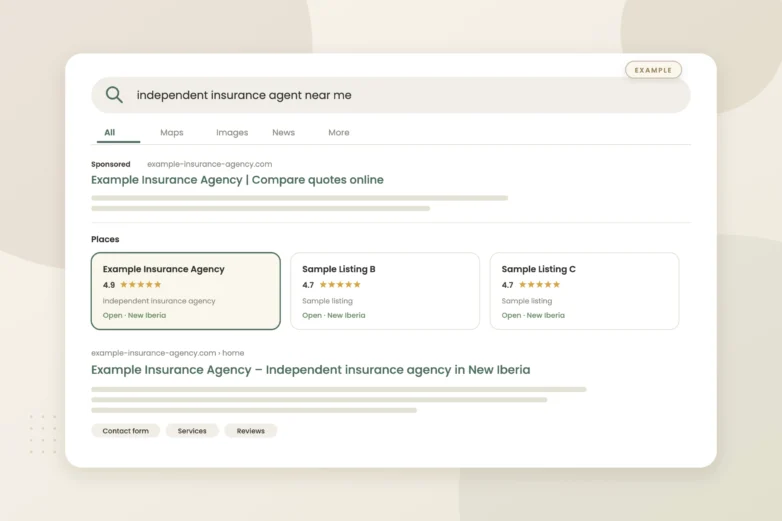
Because local insurance shopping starts on the map. Someone whose renewal just jumped searches “home insurance agent Lafayette” or “independent insurance agency near me,” and Google shows three agencies on a map before any website. Google says it ranks those results on relevance, distance, and prominence, and prominence includes how many reviews you have.
Reviews also do the selling. In BrightLocal’s 2026 consumer survey (about local businesses in general), 97% of consumers read reviews, 74% only paid attention to reviews from the last three months, and 47% said they wouldn’t use a business with fewer than 20 reviews.
A few agency-specific profile details:
- Producer profiles. Google’s guidelines allow public-facing insurance agents to have their own profile. If you’re the only agent at a branded location, Google’s example format is a shared profile like “Brand: Agent Name,” not two separate listings.
- List every line as a service. Homeowners, auto, flood, commercial, life, and so on, each with a plain-English description.
- Keep the name clean. Adding “Cheap Car Insurance” to your business name breaks Google’s guidelines and can get the profile suspended.
We go deeper on this in our local SEO service for Louisiana insurance agencies.
What’s different about marketing an agency in Louisiana?
Louisiana is one of the toughest property insurance markets in the country, and that shapes how people shop. After the 2020 and 2021 hurricane seasons, several homeowners insurers left the state or failed, and many families saw big premium increases. That has two effects on your marketing:
- Shoppers compare more. Renewal notices push people to search, and they’re looking for someone who will explain their options, not just quote a number. Content that answers real questions (wind and hail deductibles, flood coverage, what to do when a carrier leaves) earns trust and gets cited by AI tools.
- Timing matters. Search interest spikes before and during hurricane season and after storms. Plan budget around that calendar instead of spending evenly all year. Our storm-season marketing guide for Louisiana agencies covers what to publish and when.
Independent agencies have a real advantage here. You can shop multiple carriers when a captive office can’t. Say that clearly on your site and profile.
Should you count on carrier co-op money?
Use it if you get it, but don’t build your plan around it. The Big I’s 2026 study found 78% of small agencies received zero carrier marketing support in 2025, and only 39% of agencies overall got any. Co-op dollars also often come with rules about what you can say and which carrier you feature. Your own visibility (your profile, your reviews, your site) is the asset you control no matter which carriers you write with.
What should an agency do with a small budget?
- Fully build your Google Business Profile. Every field, every line of insurance as a service, real photos. Free.
- Ask every happy client for a review. Make it one tap and reply to every review. Here’s how to get more Google reviews in Louisiana.
- Make your quote form work on a phone and get back to every request the same day.
- Claim your ChatGPT profile. It’s free, and AI tools are becoming a real source of local recommendations. Here’s how to claim your business in ChatGPT.
- Write for your book. A short monthly email to current clients drives cross-sells and referrals at almost no cost.
How do you know if your marketing is working?
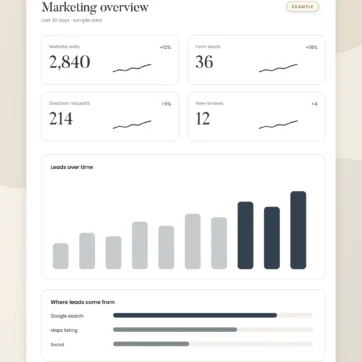
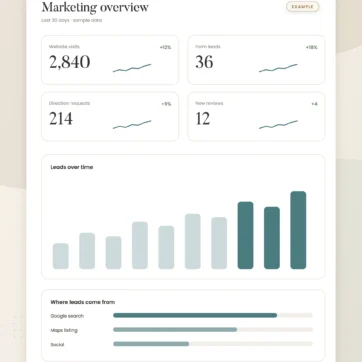
Track quotes by source, households written by source, and cost per household by source every month. Ask “how did you hear about us?” on every quote, and tag it in your agency management system. If you can’t tie a channel to written households after a few months, move that money to a channel you can. For a broader look at what’s working for agencies right now, see our guide to insurance agency marketing in Louisiana. If you also work with law firms or medical practices, we’ve written matching budget guides for law firms and medical practices.
Want to see where your agency stands?
If you want an honest read on how your agency shows up on Google Maps, in search, and in AI answers compared with the agencies around you, request a free visibility audit. I’ll show you where you’re being found, where you’re missing, and where I’d put the next dollar. You can also see how we approach insurance agency marketing and AI search optimization.
Related owner questions: Should My Insurance Agency Keep Buying Leads or Build Its Own? · Are Google Ads Worth It for an Independent Insurance Agency? · Is SEO Worth It for a Small Independent Insurance Agency?
Frequently asked questions
How much should an insurance agency spend on marketing?
The Big I’s 2026 Agency Universe Study found marketing averages 11% of total agency expenses, up from 8% in 2024, with the average agency marketing budget at about $20,600 a year. Growing agencies and agencies in competitive markets should plan above the average, and size the budget around what a new household is worth over its lifetime.
What is the average marketing budget for an independent insurance agency?
According to the 2026 Big I Agency Universe Study ACT report, the average agency marketing budget rose from $14,300 to $20,600. That’s an average across agencies of all sizes, so larger agencies typically spend more and small agencies less.
Do insurance carriers pay for agency marketing?
Some do, but most small agencies get nothing. The Big I’s 2026 study found 78% of small agencies received zero carrier marketing support in 2025, and only 39% of agencies overall received any. Build your plan so it works without co-op money.
How do you calculate what an insurance agency can spend to get a new client?
Multiply your average annual commission per household by the average number of years a household stays to get lifetime value. Then decide what share of that you’re willing to spend to win a household. Compare that to your actual cost per quote divided by your close rate.
What marketing works best for a local independent insurance agency?
A fully built Google Business Profile with a steady flow of recent reviews, a website with pages for each line of insurance and each town you serve, a quote form that works on a phone, and fast follow-up. Search ads and AI search visibility add volume once that foundation is in place.
Sources
- Big “I”: 2026 Tech & Marketing Signals, an ACT report from the Agency Universe Study — marketing share of expenses, average budget, carrier support
- Big “I” ACT report PDF (September 2026) — full figures and survey method
- The CMO Survey, Spring 2026 — marketing at 9.0% of revenue, all U.S. for-profit companies
- BrightLocal: Local Consumer Review Survey 2026 — consumer review behavior (general local businesses)
- Google Business Profile Help: Guidelines for representing your business on Google — practitioner profiles and business name rules
- Google Business Profile Help: Tips to improve your local ranking — relevance, distance, and prominence