Competitor Running Google Ads on Your Law Firm’s Name? What You Can Do
Last updated: November 12, 2026 · By Kayce Sadler, Founder & CEO, Abode Marketing
You usually can’t stop another firm from bidding on your name as a keyword, because Google’s trademark policy doesn’t restrict keyword use. What you can act on is a rival putting your firm’s name in the ad text, or an ad that makes searchers think it is your firm, and for that the main tool is a trademark complaint to Google. In the meantime, a small campaign on your own name usually puts you back on top of your own search results.
Key takeaways
- Keywords vs. ad text: Google lists “using trademarks as keywords” among uses it will not restrict, but it does restrict a direct competitor using your trademark in the ad itself.
- Complaints are advertiser-specific: Google’s trademark complaints have to identify the specific advertisers you’re reporting, by their URLs.
- Registration helps: Google acts where owners have “demonstrated trademark rights.” A USPTO or Louisiana Secretary of State registration is the cleanest proof.
- LSA has a brand setting: with Direct business search on, your Local Services ad can appear when people search your firm’s name, and it’s the only LSA shown there.
- Ethics opinions are split by state. I couldn’t find a published Louisiana opinion on keyword bidding, so take specific questions to LSBA Ethics Counsel.
Is it allowed for another firm to bid on my firm’s name?
On Google’s side, yes. The Google Ads trademark policy lists using trademarks as keywords among the things it will not restrict. So a competitor’s ad can show up when someone types your firm’s name, as long as the ad itself doesn’t use your name.
The ethics side is less settled. North Carolina’s 2010 Formal Ethics Opinion 14 treated buying another lawyer’s name as a keyword as dishonest conduct. Texas (Opinion 661, 2016) and South Carolina (Ethics Advisory Opinion 20-01) went the other way. In 2025 the New Jersey Supreme Court held the practice isn’t a violation by itself, but required a disclaimer on the landing page. I couldn’t find a published Louisiana opinion on this exact question.
Here’s my take: don’t assume what’s allowed in another state is settled in Louisiana. The Louisiana Rules of Professional Conduct bar any “false, misleading or deceptive communication” about a lawyer or firm (Rule 7.2(c)(1)). Subparagraph (J) separately addresses things like presenting a firm as a fictionalized entity and using names that suggest lawyers are associated when they aren’t. Whether a particular ad crosses that line is a question for the LSBA’s Ethics Counsel or your own ethics lawyer, not your marketing agency.
What if their ad puts my firm’s name in the headline?
That’s the situation Google’s policy actually covers. Google restricts “using trademarks in an ad from a direct competitor” and ads that use a trademark “in a confusing, deceptive, or misleading way.” Note that the name has to appear in the ad, not just on the landing page.
Before you file, collect evidence:
- Screenshots showing the full ad, the search you typed, the date and roughly where you were
- The ad’s display URL and the page it sends people to
- Your trademark registration number, if you have one
Then submit a complaint through Google’s trademark process (the policy page links to it under “Report Content On Google”). Complaints have to identify specific advertisers by their URLs, so one complaint won’t cover every firm. When Google does restrict a mark, that restriction generally covers the advertiser’s ongoing ads using the same domain.
In a legal community the size of Louisiana’s, a direct phone call between managing partners is also worth considering. Sometimes the culprit is an agency running broad match on the competitor’s behalf, and the other firm has no idea.
Do I need a registered trademark before Google will act?
Google says it accepts complaints “within the countries and industries in which trademark owners have demonstrated trademark rights.” A registration is the most direct way to show those rights. Without one, you’re making a harder argument.
Firms have two routes. A federal registration through the USPTO covers the whole country. A Louisiana registration through the Secretary of State, under La. R.S. 51:211 and following sections, lasts ten years. You can renew it in the six months before it expires, and the renewal has to state the mark is still in use in Louisiana. Which route fits, and whether your firm name can be registered at all, is a question for trademark counsel.
Should we run ads on our own firm name?
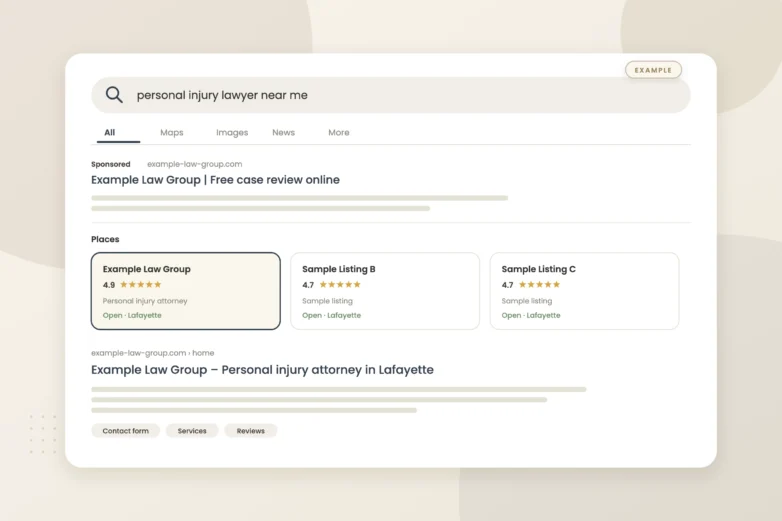
For most firms that have noticed this problem, yes. A brand campaign makes sure the first ad someone sees when they type your name is yours. It can carry sitelinks to your practice pages and a call option. Your site is the most relevant result for your own name, so you start from a strong position.
Two Louisiana-specific notes. First, websites are exempt from filing under Rule 7.8(g), but don’t assume that exemption covers paid search ads too. Ask Ethics Counsel whether your ads need to be filed under Rule 7.7. Second, if you run Local Services Ads, look at the Direct business search setting under Profile & budget. When it’s on, your LSA can appear for searches of your firm’s name, it’s the only LSA shown there, and Google asks callers whether they’re existing clients so you aren’t charged for them. LSAs can’t target another firm’s name.
How do I find out who is bidding on my name?
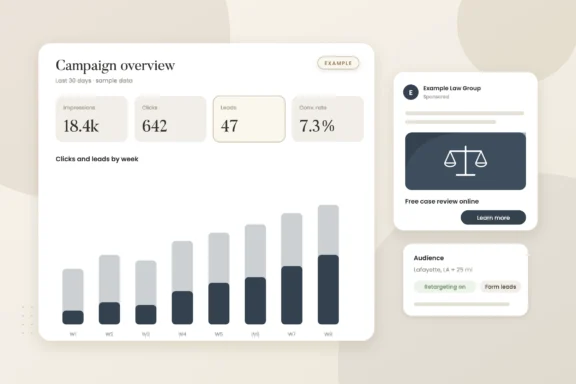
Once you have a brand campaign running, open Auction insights in Google Ads. It shows each competitor’s impression share, overlap rate, position above rate, top of page rate and your outranking share. One catch: the report doesn’t show insights when impression share is under 10%. That’s another reason to run the brand campaign even if it’s small.
| What you’re seeing | What it likely is | What you can do |
|---|---|---|
| A rival’s ad appears when people search your firm’s name, but the ad doesn’t mention you | Keyword use, which Google doesn’t restrict | Run a brand campaign, check Auction insights, turn on LSA Direct business search |
| Your firm’s name appears in their headline or description | Trademark use in ad text by a direct competitor | Document it, then file a trademark complaint naming that advertiser |
| The ad suggests it IS your firm or that your lawyers work there | Possibly “confusing, deceptive, or misleading” use under Google policy; may also raise Rule 7.2(c)(1) questions | File the complaint and ask your ethics counsel whether anything else is appropriate |
| A legal directory or lead-gen site shows on your name | May fall under Google’s exception for informational sites | Make sure your own ad and Google Business Profile outrank it; correct your listing on that directory |
| You can’t tell who’s bidding | You don’t have enough brand impressions to see the data | Run a brand campaign for a few weeks, then read Auction insights |
What we’d check first
- Your own name search, on a phone. We’d search your firm’s name and each partner’s name from a couple of parishes and screenshot everything above your Google Business Profile.
- Your Google Business Profile on brand searches. Does it show with the right name, phone and hours? Your profile is the thing a searcher should land on, not a rival’s ad.
- Paid search and LSA status. Do you have a brand campaign at all? Is Direct business search on? What does Auction insights show for overlap?
- Reviews next to the competitor. If a rival appears on your name, searchers will compare. We’d look at your review count, rating and how recent your reviews are against theirs.
- AI answers about your firm. We’d ask ChatGPT and Google’s AI Overviews about your firm by name to see whether they mix you up with someone else.
Related reading: whether Local Services Ads are worth it for Louisiana firms, how Google Ads works for smaller Louisiana businesses, and how firms show up in AI search answers.
If you’d like a second set of eyes, our free visibility audit includes a look at who’s bidding on your firm’s name, your LSA setup and what searchers see when they type your name. We’ll walk you through it in plain English.
More owner questions we’ve answered: Why Was My Law Firm’s Google Business Profile Suspended? · Should a Law Firm Have Separate Websites for Each Practice Area or Office? · Can My Business Rank in a City Where We Don’t Have an Office?
Frequently asked questions
Can my firm bid on a competitor’s name in return?
Google won’t stop you from using another firm’s name as a keyword, but that doesn’t settle the ethics question. Bar opinions differ from state to state, and I couldn’t find a Louisiana opinion on point. Ask LSBA Ethics Counsel before you do it, and never put the other firm’s name in your ad text.
Will a trademark complaint keep the competitor from showing up on my name?
Usually not. Google’s trademark policy doesn’t restrict keyword use, so a successful complaint mainly stops your name from appearing in their ads. Their ad can still show for your name with their own wording, which is why a brand campaign is often part of the fix.
Is a brand campaign wasted money if people were going to find us anyway?
It can be, if nobody else is competing for your name. That’s why you test it and read Auction insights. If rivals regularly show up on your name, the brand campaign is what keeps your firm in the first spot someone sees.
Who handles a complaint about another lawyer’s advertising in Louisiana?
The LSBA’s Ethics Counsel gives informal, non-binding guidance on the advertising rules, and the Louisiana Attorney Disciplinary Board runs the grievance process. Whether to raise a concern about a competitor’s ad is a decision for you and your ethics counsel. Your marketing agency shouldn’t make that call.
How long does a Louisiana trademark registration last?
Ten years from the date of registration. You can renew in the six months before it expires, and the renewal has to state the mark is still in use in Louisiana. Federal registration through the USPTO is a separate process with its own rules.
Sources
- Google Ads Help: Trademarks policy — Keywords not restricted; ad-text use by direct competitor and confusing use restricted; complaints within demonstrated trademark rights; complaints name specific advertisers
- Louisiana Secretary of State: Trade name/mark renewal instructions — Ten-year term under La. R.S. 51:216, renewal within six months of expiry, must still be in use in Louisiana
- Local Services Help: About direct business search — LSA on brand searches, sole LSA shown, returning-customer screening, can’t target other brands
- Google Ads Help: Use auction insights to compare performance — Auction insights metrics and 10% impression share threshold
- South Carolina Bar: Ethics Advisory Opinion 20-01 — Permits competitor-name keywords; summarizes NC 2010 FEO 14, Texas Op. 661, NJ
- NJ Appellate Law blog: Supreme Court on competitor-name keywords (May 2025) — 2025 NJ Supreme Court holding plus landing-page disclaimer requirement
- LSBA: Lawyer Advertising Rules (effective Jan. 1, 2022) — Rule 7.2(c)(1) and (J), Rule 7.7 filing, Rule 7.8(g) website exemption