How the Google Map Pack Works in 2026 (and How Louisiana Businesses Get In)

Ask any Louisiana small-business owner where their new customers come from and, sooner or later, the answer is Google. And on Google, the piece of real estate that matters most for a local business is the little map with three businesses pinned under it — the map pack. Land in it and the phone rings. Miss it and you’re relying on people scrolling past your competitors to find you. Here’s exactly how the map pack works in 2026, and what actually gets a Louisiana business into it.
What the map pack is — and why it’s the whole game locally
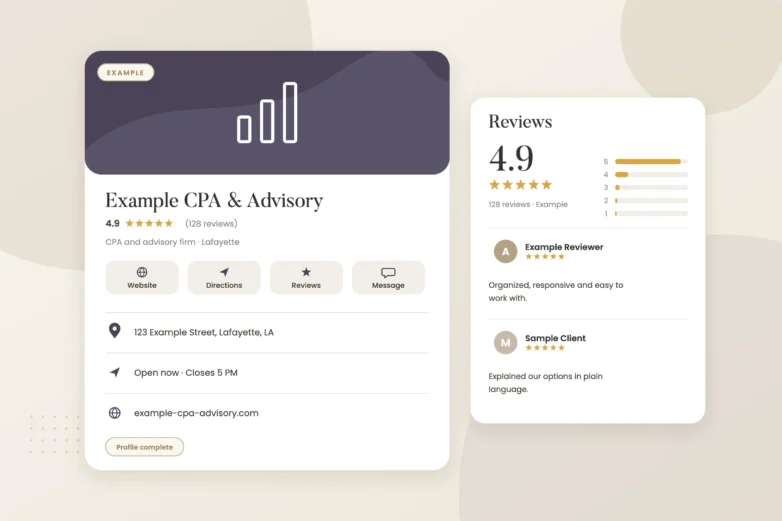
When someone searches for a local service — “plumber near me,” “dentist in Lafayette,” “roofer Baton Rouge” — Google shows a map with three businesses highlighted right at the top, above the regular blue-link results. That block is the map pack (sometimes called the local pack or the 3-pack). It sits above everything else, it shows your star rating and reviews, and on a phone it comes with a tap-to-call and directions button. That’s why it captures the overwhelming share of clicks and calls for local searches. For most Louisiana service businesses, getting into the top three of the map pack is worth more than any other single thing you can do online.
The good news: the map pack is intensely local. You’re not competing with the whole state or the whole country — you’re competing with the handful of businesses near the person searching. That’s the core idea behind local SEO, and it’s very winnable for a focused small business.
The three things Google uses to rank the map pack
Google is refreshingly open about this. It ranks local results on three factors: relevance, distance, and prominence. Everything you do to climb the map pack ladders up to one of these three.
Relevance — does your business match what they searched?
Relevance is how well your business fits the search. Google figures this out from your Google Business Profile and your website: your primary category, the services you list, your description, and the content on your site. A business with a vague, half-filled profile looks less relevant than one that clearly states exactly what it does. This is the fastest lever most businesses can pull — pick the most accurate primary category, add secondary categories for everything else you do, and list out every service.
Distance — how close are you to the searcher?
Distance is how far your business is from the person searching (or from the town they named). You can’t move your office, but you can make sure Google knows exactly where you are and which communities you serve — a consistent, correct address, service-area settings, and location pages on your site for the towns you cover. In Louisiana, where people search by town and by parish, this matters enormously: a business that clearly signals it serves Youngsville, Broussard, and Carencro — not just “Lafayette” — can win searches across a whole corner of a parish.
Prominence — how well-known and trusted are you?
Prominence is Google’s read on how established and reputable your business is. Reviews are the biggest piece of this for most small businesses: how many you have, how recent they are, your rating, and whether you respond. Links from other local sites, mentions in local news, and consistent listings across the web all feed prominence too. This is where a steady stream of fresh reviews pays off — and it’s why we treat reputation and reviews as a core ranking system, not an afterthought.
What actually gets a Louisiana business into the map pack
Turn those three factors into a to-do list and it looks like this. First, claim and fully build your Google Business Profile — every field, the right categories, real hours, services, and current photos. A complete profile earns far more clicks than a bare one, and completeness itself is a signal. Second, get your name, address, and phone number identical everywhere online — your site, Facebook, the Chamber, industry directories, Apple Maps. Mismatches make Google less confident and cost you rank. Third, build a review engine: ask every happy customer for a review at the right moment, and reply to every review that comes in. Fourth, make your website genuinely local — a real page for each core service and each town you serve, written for the way people actually search. Fifth, keep it going. The map pack isn’t set-and-forget; your competitors are working on the same three factors, so consistency is what holds the top spot.
Why the Louisiana angle matters
A national playbook treats every market the same. Louisiana isn’t. People here search by parish and by community, trust word of mouth heavily, and reward businesses that clearly belong to their town. That’s an advantage for a local owner who leans into it — you can own the map pack in your community with far less fight than a big-city business faces. We’ve done exactly this across industries: the same local-search foundation is behind our work for Louisiana medical practices and Louisiana law firms, and it’s how Apex Spine and Pain Center went from zero walk-ins to five a day.
Where to start
The fastest first step is to find out where you actually stand. Pull a free visibility audit and we’ll show you your current map-pack rank, your review gap versus the business beating you, and the two or three moves that would help most. When you’re ready to build a plan, book a strategy call and we’ll map out how to get your business into the top three — and keep it there.
None of this is guesswork about how Google works. Google publicly explains that local results are ranked on three things — relevance, distance, and prominence — and that keeping a complete, accurate Google Business Profile with steady reviews is how you strengthen the prominence signal you can actually control (Google Business Profile Help). Independent analysis agrees: BrightLocal’s ongoing study of the local algorithm ranks Google Business Profile signals and reviews among the heaviest factors in who lands in the map pack (BrightLocal — Google’s local ranking factors).
Frequently asked questions
How long does it take to get into the Google map pack?
Completing and optimizing your Google Business Profile and cleaning up your listings can move the needle within a few weeks. Building the review volume and consistency to hold a top-three spot in a competitive category usually takes a few months of steady work. It’s an ongoing program, not a one-time fix.
Do I need a website to rank in the map pack?
You can appear without one, but you’ll rarely win a competitive search without a fast, relevant website behind your profile. Google uses your site to judge relevance, and a good site is what turns a map-pack click into an actual call or booking. Profile and website work together.
How important are reviews for local ranking?
Very. Review count, recency, your rating, and whether you respond are among the strongest signals of prominence, which is one of Google’s three local ranking factors. For customers deciding between two businesses, reviews are often the deciding factor too, so they help you rank and help you convert.
What’s the difference between the map pack and regular Google results?
The map pack is the block of three businesses shown on a map at the top of local searches, ranked on relevance, distance, and prominence. The regular organic results below it are the standard blue links, ranked mostly on your website’s content and authority. Winning locally usually means competing in both, but the map pack drives the most calls.
Can a small business really outrank bigger competitors locally?
Yes — that’s the point of local SEO. Because ranking depends heavily on distance and on prominence signals like reviews, a focused local business that fully optimizes its profile and out-earns competitors on fresh reviews can beat larger, less-attentive rivals in its own community.
Serving Louisiana and beyond. Abode works remotely with local businesses across the Gulf South and Southeast, one client per market. See the areas we serve, including our pages for New Iberia, LA and Thibodaux, LA.