Local SEO and Google Maps for Law Firms in Louisiana: How to Get Into the Local Pack
Last updated: November 12, 2026 · By Kayce Sadler, Founder & CEO, Abode Marketing
To get a Louisiana law firm into Google’s local pack, you need three things working together: a Google Business Profile that matches what people actually search (the right categories, practice areas, and a real staffed office), a steady flow of recent reviews, and a website with practice-area pages that back up the profile. Google says local results are based on relevance, distance, and prominence, so your job is to win the two you can control and stop leaking the one you can’t. Below is the full playbook for Louisiana firms, parish by parish, including the parts most national guides skip.
Key takeaways
- The local pack is its own race. It pulls from your Google Business Profile, not just your website, so a firm can rank on page one organically and still be missing from the map.
- Google ranks the map on relevance, distance, and prominence. You can’t move your office closer to every searcher, but you can control relevance (categories, services, pages) and prominence (reviews, links, mentions).
- Louisiana searches are parish-shaped. People search “Houma car accident lawyer,” “Lafayette Parish DWI attorney,” and “lawyer near me.” Your profile and pages need to speak the same language.
- Reviews are the lever most firms under-use. In BrightLocal’s 2026 survey, 74% of consumers only paid attention to reviews from the last three months.
What is the local pack, and why does it matter so much for law firms?
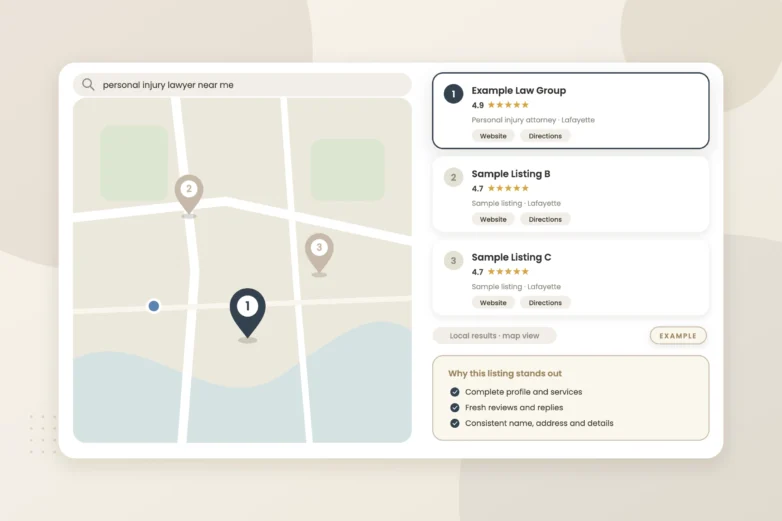
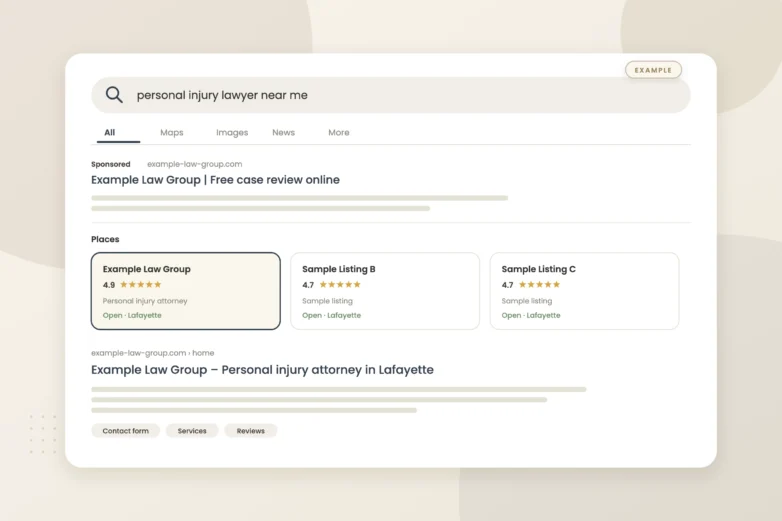
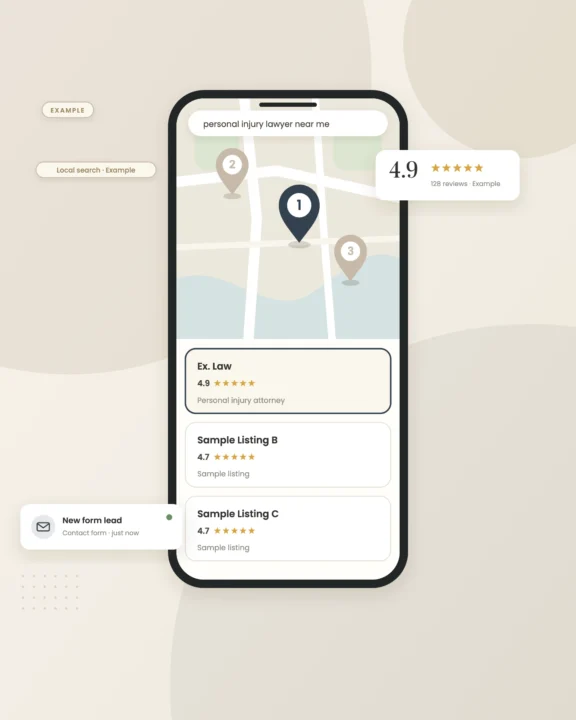
The local pack is the box of three businesses with a map that shows up when someone searches for a lawyer near them. On a phone, it often fills the whole first screen. For a personal injury or criminal defense firm, that box is where a lot of first calls come from, because the person searching usually needs help now and taps the first firm that looks trustworthy.
Here’s the part that trips firms up. The local pack is built from your Google Business Profile and the signals around it, not only from your website. I see Louisiana firms whose site ranks fine in the regular results and still don’t show up in the map. Two different races, and you have to run both. (For the quick troubleshooting version, see why a law firm isn’t showing up in Google’s map pack.)
How does Google decide which law firms show up on the map?
Google is unusually clear about this. Its own help page says local results are mainly based on three factors:
| Factor | What Google says it means | What a Louisiana firm can actually control |
|---|---|---|
| Relevance | “How well a Business Profile matches what someone is searching for.” | Primary and secondary categories, services listed by practice area, a description that names your real practice, and matching practice-area pages on your site. |
| Distance | “How far each business is from the customer who’s searching.” | Only where your real, staffed offices are. You can’t fake this, and trying to (virtual offices, fake suites) risks suspension. |
| Prominence | “How well-known a business is,” including links and how many reviews you have. | Review count, rating, and recency, local links and mentions, consistent listings across directories, and your site’s overall authority. |
Google also says plainly that there is no way to request or pay for a better local ranking. So when someone promises they can “get you to the top of the map” by next month, that’s your cue to ask exactly which of these three they are changing.
How do people in Louisiana actually search for a lawyer?
This is where national guides miss Louisiana completely. Our state is organized by parishes, and people search the way they talk. A few patterns I see constantly:
- City plus practice area: “car accident lawyer Houma,” “personal injury attorney Lafayette,” “divorce lawyer Baton Rouge.”
- Parish plus practice area: “Terrebonne Parish DWI lawyer,” “St. Tammany family law attorney,” “Lafayette Parish criminal defense.” Courthouse and parish names matter because that’s where the case will be.
- Near me and no location at all: “DWI lawyer near me” or just “injury lawyer.” Google fills in the location from the phone, which is why distance matters so much.
- The words Louisiana uses: people search “DUI,” “DWI,” and sometimes “OWI.” Louisiana’s statute calls the offense operating a vehicle while intoxicated, so a criminal defense page should use all three terms naturally. The same goes for “maritime” versus “Jones Act” versus “offshore injury” along the coast.
If someone in Thibodaux searches “Lafourche Parish car wreck lawyer” and your profile and site never mention Lafourche, Thibodaux, or car wrecks, you’re asking Google to guess.
How should a law firm set up its Google Business Profile?
The profile is the foundation of the map, so get these right before anything else.
Pick the categories that match your money cases
Your primary category carries the most weight. A personal injury firm should lead with “Personal injury attorney,” not the generic “Law firm.” A defense firm might lead with “Criminal justice attorney” and add “DUI attorney” as a secondary. Then add secondary categories only for practice areas you actually take, like family law, workers’ compensation, or estate planning. Check the exact names in Google’s category picker, and don’t add categories just because they’re keywords. Google’s guidelines say not to.
List every practice area as a service
Under services, list each type of case separately (car accidents, truck accidents, maritime injuries, wrongful death, DWI defense, and so on) with a short plain-English description. This is one of the easiest relevance wins, and most Louisiana firms skip it.
Use your real name, nothing extra
Google’s guidelines say your business name should match what’s on your sign, letterhead, and website. Adding “Best Car Accident Lawyer Lafayette” to the name can get the whole profile suspended. It may work for a few weeks. It isn’t worth the risk to a firm’s reputation.
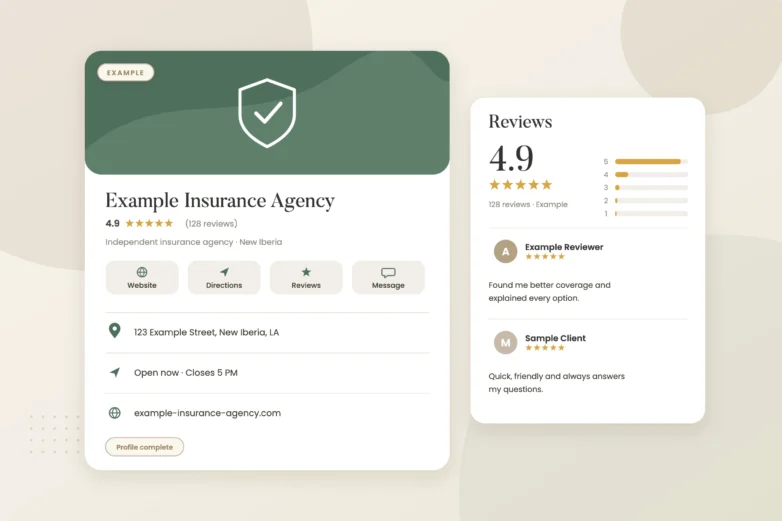
Then add real office photos, accurate hours, and a phone number that a person answers. Our Google Business Profile checklist for Louisiana law firms covers every field.
Office, service area, or satellite office: what does Google allow?
This is the question I get most from firms that want to rank in more than one town. Here’s what Google’s guidelines say:
| Situation | Eligible for its own profile? | What to know |
|---|---|---|
| Main office where you meet clients | Yes | Show the address. This is your strongest profile. |
| Second staffed office (for example, Lafayette firm with a real Thibodaux office) | Yes | Needs its own staff and hours. Each location gets one profile. |
| Virtual office or mail drop | No | Google says a virtual office isn’t eligible for a Business Profile. |
| Coworking space | Only in limited cases | Needs clear signage, customers received there during business hours, and your own staff present. |
| Individual attorneys at the firm | Often, yes | Public-facing practitioners can have their own profile. If you’re the only attorney at a branded firm, Google says to share one profile instead of creating two. |
The honest truth: a firm with one office in Lafayette will have a hard time showing up in the Houma map, because distance is the one factor you can’t fake. You can still win Houma in the regular results with a strong practice-area page and with Local Services Ads, which show above the map. That’s a smarter path than renting a virtual suite.
How do duplicate and outdated listings hurt a law firm?
Duplicates quietly split your reviews and confuse Google about which listing is real. The usual suspects: a listing at an old office address, a profile an attorney made at a former firm, or separate firm and solo-attorney profiles for the same office. Search your firm name, your attorneys’ names, and your phone number on Google Maps, then close or merge anything outdated. Google’s rule is one profile per business per location.
How many reviews does a law firm need to rank in Louisiana?
There’s no magic number, because it’s relative to the firms around you. What matters is how your count, rating, and recency compare to the three firms currently in the pack for your main search. Prominence is the factor Google explicitly ties to “how many reviews you have.”
The recency piece is bigger than most firms think. In BrightLocal’s 2026 Local Consumer Review Survey (a survey of U.S. consumers about local businesses in general, not law firms specifically):
- 97% of consumers read reviews for local businesses.
- 74% only paid attention to reviews written in the last three months.
- 47% said they wouldn’t use a business with fewer than 20 reviews.
- 89% expect the owner to respond to reviews.
So a firm with 300 reviews but nothing new since spring can lose ground to a firm with 80 reviews and a few new ones every week. Build a simple system: ask every satisfied client at the right moment, make it one tap, and reply to every review. We broke that down in how to get more Google reviews in Louisiana.
One Louisiana-specific caution: if you feature reviews or case results on your website or in ads, Louisiana’s Rule 7.2 bars references to past results without a disclaimer such as “Past results are not a guarantee of future success,” and bars paid testimonials unless the payment is disclosed. When you reply to reviews, keep it to thanks and never confirm details of someone’s case.
What does your website need to back up the map?
Your profile tells Google you’re relevant. Your website proves it. For each money practice area, you want one strong page that answers the real questions a client has, names the parishes and courthouses you work in, and links to your profile and contact info. Think “Car Accident Lawyer in Houma” with real local substance, not a thin page with the city name swapped out.
Match your site’s name, address, and phone to the profile exactly, add LegalService or Attorney schema, and link the profile to your strongest relevant page. Our local SEO service for Louisiana law firms covers how we build this out.
Do citations and directories still matter?
Yes, mostly as a consistency check. Make sure your name, address, and phone match exactly on your website, Apple Business Connect, Bing Places, Yelp, the BBB, your Louisiana State Bar listing, and legal directories like Avvo, Justia, and FindLaw. The most common mismatch I see is an old suite number or tracking phone number.
What if a competitor is running ads on your firm’s name?
This happens a lot in Louisiana personal injury. You search your own firm name and another firm’s ad sits on top. Under Google’s trademark policy, Google does not restrict competitors from bidding on your name as a keyword. It can restrict a direct competitor from using your trademark in the ad text itself, after the trademark owner files a complaint.
In practice: run a small branded campaign so your firm holds the top spot on its own name (it’s usually inexpensive because your ad is the most relevant), check your branded results monthly on a phone, and if a competitor puts your firm name in their ad copy, talk to your trademark counsel about Google’s complaint process.
How does Google Maps connect to AI search and ChatGPT?
The same signals that win the map now feed AI answers. Google’s AI Overviews pull from Business Profiles, reviews, and well-structured pages, and in BrightLocal’s 2026 survey, 45% of consumers said they’d used ChatGPT or another AI tool to get local business recommendations, up from 6% the year before.
ChatGPT now also lets businesses claim a profile. If you haven’t done it yet, our step-by-step guide on claiming your business in ChatGPT walks you through it. A clean Google profile, consistent citations, and clear practice-area pages are what make those AI tools confident enough to name your firm. That’s the core of our AI search optimization work.
Where do Local Services Ads fit with local SEO?
Local Services Ads show above the map, charge per lead, and lean on the same signals: reviews, responsiveness, and a verified profile. Treat them as a layer on top of local SEO, not a replacement. See whether Local Services Ads are worth it for Louisiana law firms for real cost-per-lead data, and how much a law firm should spend on marketing for how to split the budget.
A simple 90-day plan for a Louisiana law firm
- Weeks 1–2: Fix categories and services, correct hours, add photos, clean up duplicates.
- Weeks 2–4: Make your name, address, and phone identical across your site and directories.
- Weeks 3–8: Build one strong practice-area page per money case type, with real parish-level substance.
- Every week: Ask for reviews and reply to every one.
- Week 6 on: Protect your brand name, claim your ChatGPT profile, and decide whether Local Services Ads fit your case value.
Rankings don’t move on a promised timeline, and nobody can promise you a spot. These are the signals Google says it uses, and working all of them consistently is how a firm earns its way into the map.
Want to see where your firm stands?
If you want an honest look at how your firm shows up in the map, in the regular results, and in AI answers for your main practice area, request a free visibility audit. I’ll show you who’s in the pack for your searches, why they’re there, and what I’d fix first. We work with one firm per market, so the plan is built around your town, not a template.
Related owner questions: Competitor Running Google Ads on Your Law Firm’s Name? What You Can Do · Why Was My Law Firm’s Google Business Profile Suspended? · Changing Your Law Firm’s Name? How to Keep Your Google Rankings and Reviews · Are Avvo, Justia, FindLaw and Super Lawyers Profiles Still Worth It in 2026? · Should a Law Firm Have Separate Websites for Each Practice Area or Office?
Frequently asked questions
How do I get my law firm into the Google local pack?
Focus on the three factors Google uses: relevance, distance, and prominence. Choose the right primary category for your main practice area, list every practice area as a service, keep your name, address, and phone consistent everywhere, build strong practice-area pages on your site, and get a steady flow of recent Google reviews. You can’t change distance, so win on relevance and prominence.
Can a law firm rank on Google Maps in a town where it has no office?
It’s hard. Distance is one of Google’s three local ranking factors, and Google says virtual offices aren’t eligible for a Business Profile. A firm can still win that town in the regular organic results with a strong practice-area page, and through Local Services Ads, which show above the map.
What Google Business Profile category should a personal injury firm use?
Lead with “Personal injury attorney” as the primary category rather than the generic “Law firm,” then add secondary categories only for practice areas you actually take. Check the exact names in Google’s category picker, and don’t add categories just as keywords.
How many Google reviews does a law firm need?
There’s no fixed number. Compare your review count, rating, and recency to the three firms in the pack for your main search. Recency matters: in BrightLocal’s 2026 survey, 74% of consumers only paid attention to reviews from the last three months.
Can another law firm bid on my firm’s name in Google Ads?
Under Google’s trademark policy, competitors can generally bid on your name as a keyword. Google can restrict a direct competitor from using your trademark in the ad text after a complaint. Running a small branded campaign helps you hold the top spot on your own name.
Does local SEO help my firm show up in ChatGPT and AI Overviews?
Yes. AI tools lean on the same signals: an accurate Business Profile, consistent listings, recent reviews, and clear practice-area pages. ChatGPT now also lets businesses claim a profile, which is worth doing once your Google profile is clean.
Sources
- Google Business Profile Help: Tips to improve your local ranking on Google — relevance, distance, and prominence definitions
- Google Business Profile Help: Guidelines for representing your business on Google — virtual offices, coworking, practitioners, business names
- Google Ads Help: Trademarks policy — keyword vs. ad-text use of trademarks
- BrightLocal: Local Consumer Review Survey 2026 — consumer review and AI-recommendation stats (general local businesses)
- Louisiana Rules of Professional Conduct, Rule 7.2 — past-results disclaimers and testimonials